
A Literary Journal
Goats
When I was six, my parents and I moved to a house in a new subdivision in northeastern Ohio that butted up against what had previously been farmland. Our neighbor, Ed, lived in a farmhouse that was barely a stone’s throw from our back yard, and its barn and pen shared our property line fence. I spent a lot of time leaning over that fence marveling at his goats.
I suppose Ed was probably in his early seventies at the time. Short and squat, he appeared gruff and taciturn, but I soon learned that his watery eyes belied quiet warmth. He lived alone, and he truly loved the goats—talking to them, cooing at them, calling them his girls. At first, Ed appeared to ignore me there at the fence, but gradually started to answer my questions about the goats and even offer unsolicited snippets of information about them. Eventually, he began allowing me to climb over to provide mostly useless assistance with them.
* * *
My dad was an accountant and my mom did alterations at home for a men’s clothing store in town. I was an only child until my little brother, Ben, was born with all his challenges during our second year in the new house. He spent six weeks in the NICU and another eight in a unit for medically fragile children before he was finally able to come home with tracheal and gastric tubes and a host of complications. I heard my parents speaking in strained voices with specialists about him, phrases like “undiagnosed genetic syndrome,” “will never developmentally be more than six months old,” “dependent on adult care for all living needs.” Unless one of us was holding Ben, he spent almost all his time in a special hospital bed in the room we shared hooked up to an oxygenator, feeding pump, suction machine, and sat monitor whose cacophony of sounds became a kind of serenade to my youth. My parents took turns overnight repositioning him, suctioning his trach, administering meds through his G-tube, and adjusting his feed; they both seemed exhausted most of the time.
When were alone together in the room, I often stood at Ben’s bedside and watched him sleep or stare off at whatever it was he looked at. I’d wipe the drool away from his chin and trach ties, and sometimes I’d read or sing to him, tickle his feet. I wasn’t sure, but on a couple of occasions it seemed as if he might have smiled.
* * *
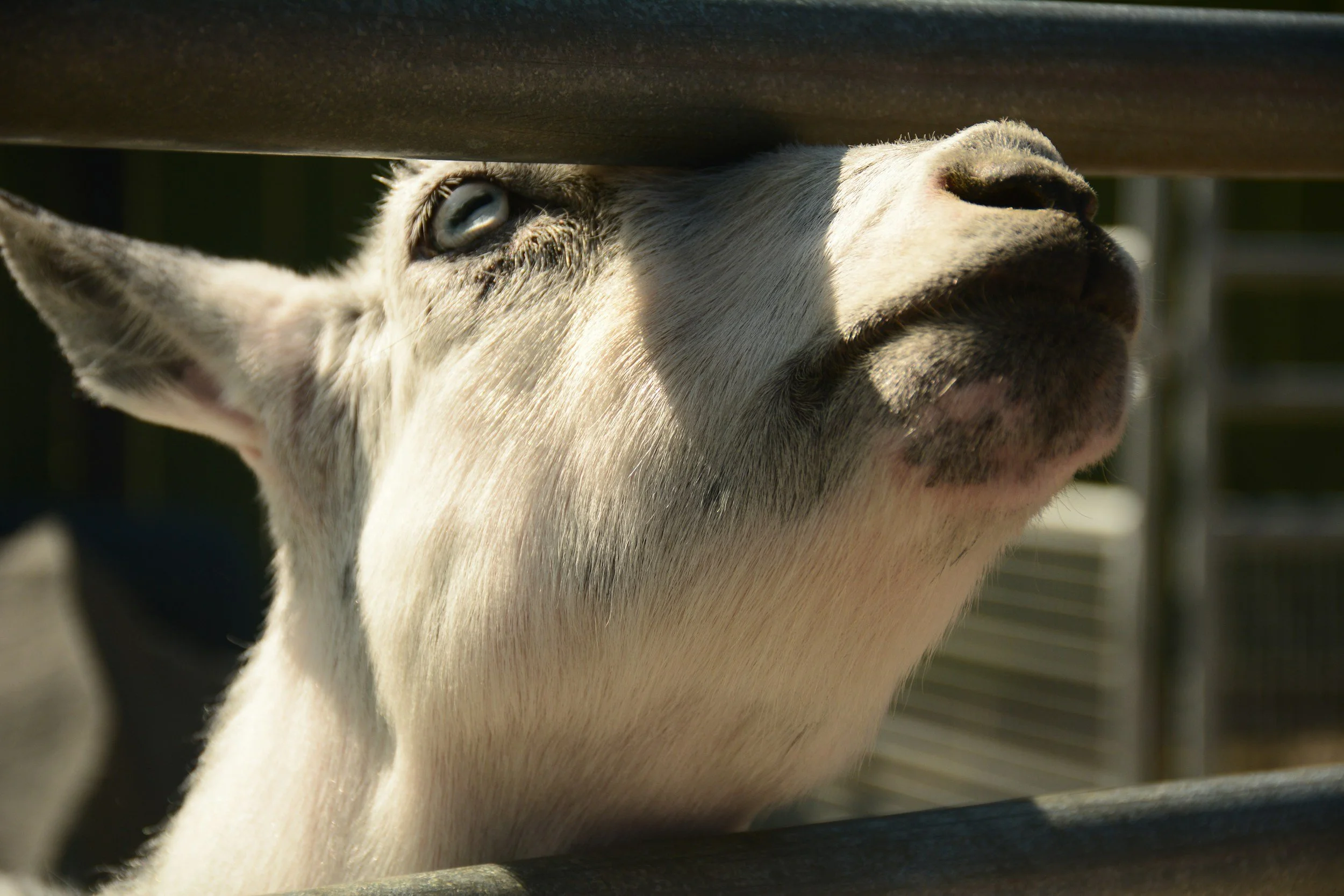
I learned a lot about goats through my observations and directly from Ed. For example, they’re surprisingly intelligent and sociable animals, good-natured and curious. They respond to each other’s voices and those of humans to whom they’re accustomed. They’d each come separately to Ed when he called them by name: Maud for the mom, Alice for her older doe, and Gretchen for the younger. Their particular breed had black-and-white coloring, no horns, floppy ears, wattled necks, and soft fur. They ate the hay and grains from their pen’s trough, as well as bushes, thistles, and grass when he let them out into one of his near fields.
Another curious thing about goats is their eyes. They have rectangular pupils and often gaze uninterrupted at someone, particularly if there’s a problem they can’t solve such as reaching a low-hanging branch or not being able to free a bramble from their fur. Those eyes seemed to me to hold a sort of yearning, as well as a tenderness approaching empathy that I found both startling and endearing.
* * *
Ben had frequent hospitalizations, most commonly for pneumonias and respiratory ailments, to which he was prone. Sometimes he had to be admitted for more than a week at a time. When that occurred, I visited him in his hospital room with one or both of my parents. It was unsettling to see him lying there, hooked up to wires and probes and with a nasal canula wrapped around his little ears that led to prongs in his nostrils. Nurses scurried in and out, the sounds of rolling carts and muffled voices came from the hallway, and a disinfectant-like smell always hovered in the air. While we were there, I often found my mom struggling to control her silent tears. She fussed over Ben, rearranging his blankets, smoothing the hair over his misshapen crown, dabbing at his closed eyes with warm, dampened washcloths, kissing his cheeks.
During those admissions, my dad always spent the night in Ben’s room, attempting to sleep in a chair at his bedside. When he did, my mom usually lingered after tucking me into my own bed, sometimes crawling in next to me and curling up against me in the darkness. It was not uncommon for me to find her still there, fully clothed, in the morning.
* * *
Goats are very selective eaters insofar as they won’t consume anything on the ground or a dirty surface. They like to prance and jump. Their lips, tongues, and teeth are their primary grazing tools, and because their lower jaws are wider than their upper, they can only chew on one side of their mouth at a time, which can appear kind of comical.
They also respond well to training and instruction. I was amazed one afternoon to see Gretchen fetching an old tennis ball Ed rolled across the barn floor.
I asked, “You teach her to do that?”
“Comes naturally to them.”
After Gretchen retrieved the ball, Ed scratched her ears while she butted at his hand with affection.
“You ever have any other animals, Ed?”
“Used to … chickens, couple pigs, an old mule.”
“What happened to them?”
“Gave them away.” He issued me a glance, then returned his attention to Gretchen. “After my wife died. She was the one who tended them.”
I watched his hands quicken down over Gretchen’s beard and wattle, then said, “Shucks.”
He nodded, yanked a handkerchief out of his overall pocket, and blew his nose without looking back my way.
* * *
Shortly after Ben turned two, my parents got him a tiny wheelchair that had an attachment for a portable oxygen tank. In nice weather after I got home from school, my mom and I usually took him for a walk in it through the neighborhood. At first, I was bothered by the way people halted what they were doing to stare at Ben, their expressions full of shock, distaste, or even horror. But my mom always ignored those reactions with a muted dignity and grace that I tried in vain to model myself.
My mother had grown up skating in northern Michigan and taught me how to skate early on. Across the street from our house was a shallow pond in a stand of trees that froze over quickly in the winter and was large enough for skaters. People would build a little fire in a rock ring at the pond’s edge and place wooden crates around it for sitting. In the late afternoon before we laced on our skates, my mom sometimes pushed potatoes wrapped in foil down into the fire’s glowing coals and a papered stick of butter into the snow. After we finished skating, the two of us would sit close together, gingerly unwrap our steaming potatoes, smear the butter down into them, and eat them like Ed’s goats in their trough.
On occasion, my dad bundled Ben up and brought him across in his wheelchair to join us for a potato. My mom would put a fingertip of the warm, buttered mash onto Ben’s tongue. Then we’d watch him make one of his curious frowns and the squawking sound we associated with his experiencing a measure of pleasure.
* * *
I was surprised to learn that goats see especially well in the dark. When I came out to the back fence at night after dinner with some lettuce or celery, they’d leave the barn and trot out to me at the fence without my having to call to them at all. I enjoyed the way they flapped their tongues as they mouthed the treats from me. And they always nuzzled my hand after I fed them, which stirred something inside me.
My parents and I sometimes pushed Ben in his wheelchair out back so the goats could lick his hands or cheeks through the fence. His face always filled with a puzzlement when they did. Ed usually joined us there on those occasions and chuckled with my parents over the interactions, which seemed to draw the three of them closer together.
My sojourns over that fence became so frequent that one afternoon after my mom, Ben, and I returned from seeing a movie, we found my dad and Ed out back putting the finishing touches on a gate adjoining our properties. When I scampered out to them, astonished, my dad just tousled my hair and said, “No more climbing over that damn fence. Don’t need you ending up in the hospital, too.”
* * *
Around the time Ben turned three, his seizures began growing more frequent and intense. His arms and legs would suddenly stiffen, his expression became alarmed, then he’d start to shake. Just sort of a steady tremble at first that soon became violent. His eyes would roll back; froth would emerge at the corners of his mouth. Sometimes the whole episode would take a minute or more, which I always found frightening and unnerving.
His neurologist had him on an ever-changing cocktail of anti-convulsive meds and told us to just hold his hand and gently reassure him until the seizure passed, unless it persisted for more than five minutes or clustering occurred. That only happened a half-dozen or so times that I recall, but when it did, one of my parents had to inject him with a syringe of rectal valium. He usually whimpered almost soundlessly afterward while we stroked one of his sweaty palms until he fell into a deep postictal sleep. It was always a great consolation when that slumber finally began.
* * *
I fell into a satisfying afternoon ritual with Ed where I’d brush his goats while he milked them from a short stool in the dusty light of his barn. I asked him once why he didn’t just buy regular milk like most people.
“This here’s better for you,” he told me in his matter-of-fact manner.
I watched him rhythmically squeeze Alice’s pair of teats while the streams of milk splashed into a small metal canister, then asked, “How so?”
“Well,” he said, his hands continuing their motion, “more vitamins and minerals, for one thing.”
“You just drink it like that?”
“Yup. This goes straight in my fridge when I’m done.”
“You do anything else with it beside drink it?”
“Oh, sometimes I make some butter or cheese. Sort of a bother anymore, though.” We both stopped to watch a tractor chug by slowly in an outer field of soybeans. “Just like tending those crops, which is why I gave that up and started leasing out the land.”
Alice gave a little bleat that seemed to be a reminder for us to resume our tasks, which we both did. As the sound of the tractor died away, Ed patted her flank, then muttered, “Don’t get old … either of you.”
* * *
Sometime around age four, Ben began spending more and more of his time sleeping. He also had gall bladder removal surgery and needed to have a supra-pubic catheter inserted to help control his bladder function. Constipation became a more persistent problem, resulting in enemas and messes I heard my parents swearing about from the hallway.
I shared most of Ben’s increasing medical problems with Ed while we were doing our afternoon milking. He usually just listened and nodded, but also began giving my mom plastic bottles of goat milk he encouraged her to mix with Ben’s formula for therapeutic purposes, which I never saw her use. And I started to see Ed out in one of his fields with a sort of harness yoked to Maud, coaxing her to tug him forward.
Perhaps a month later, on a warm, early-fall Saturday, my parents and I had Ben out in his wheelchair on the back patio while we ate lunch. As we were finishing, Ed gave a whistle from the goat pen. When we looked over, he was leading Maud across the pen by the harness I’d seen him using that was tethered to a wagon piled with pillows. Ed grinned at us when they reached the gate and said, “Thought Ben might like to try taking a little ride.”
My mom laughed and clapped her hands together once. I heard my father mumble, “Son of a bitch.” But he was grinning, too.
It took us a while to transfer Ben from his wheelchair into the wagon and get him propped up and situated in it with his oxygen tank and catheter bag. Once we did, Ed didn’t hesitate for a moment; he just clicked to Maud, snugged his hand into the harness at her muzzle, and led her slowly around the pen with Ben wide awake and squawking in the wagon behind them. The midday light was white, I remember, the sky cornflower blue, and a soft breeze rustled Ben’s hair. I joined my mom with periodic clapping and gleeful shouts while my dad ran into the house. He returned with a disposable camera and snapped shots of the wagon procession.
Every now and then, Maud emitted a little snort and twisted her head to regard her passenger. But her movements were unhurried, unruffled, almost cautious, and her eyes held a kind of patient tenderness. The three of them made a couple of circuits of the pen before Ben began slumping in the wagon. We returned him to his wheelchair. Once he was strapped into it again, my mom reached out, grasped one of Ed’s hands in both of her own, and mouthed the words, “Thank you.”
“Of course,” Ed told her. “We’ll do it again. Anytime.”
* * *
Unfortunately, another time wasn’t to come. Two weeks later, Ben was admitted to the ICU again for an especially bad pneumonia, plus seizures that just kept clustering regardless of intervention. He was also diagnosed with acute pancreatitis, something I overheard two of his nurses describing in whispers as being more painful than childbirth. I could only hope that Ben didn’t experience pain like the rest of us, and I had to squeeze my eyes shut against the constant quivering from his spiraling seizures.
On the fifth evening of that admittance, a grim-faced doctor came into the waiting room, sat down at the edge of a chair across from my parents, and spoke very slowly but distinctly to them while I stood straight-backed beside them. The doctor used terms like “sepsis,” “seizures simply beyond control,” and “at our ten liters max of oxygen and still failing.” He kept saying how sorry he was, that they’d done everything possible. He grasped both my parents’ hands in his own before pressing his lips into a tight line and leaving. I watched my parents weep, my mom’s face turned into my dad’s chest.
* * *
Nearly three decades later, after both my parents had passed away, I met the woman who would become my wife. Two years afterwards, we were overjoyed to welcome a healthy son whom we named Charlie. Now that he’s old enough to enjoy interacting with animals, we like to take him to a petting zoo. A robust and energetic three-year old, he especially enjoys feeding the little goat they have there. It’s a Nigerian Dwarf, a different breed from Ed’s, known for its small size and gentle nature with children. Like Ben, Charlie delights in its friendly gaze and how its tongue scratches his hand. When he snuggles up to the goat and looks at me with unbridled joy and wonder, I see a child whose future is filled with hope and promise, and it’s all I can do not to cry with gratitude.
WILLIAM CASS
William Cass has published four hundred short stories and won writing contests at Terrain.org and The Examined Life Journal. He’s been nominated once for Best of the Net, twice for Best Small Fictions, and six times for the Pushcart Prize and had three short story collections released by Wising Up Press.