
A Literary Journal
To Our Vandal
Good Samaritan Window, dedicated in 1965 to the memory of John D. Rockefeller, Jr.
Union Church of Pocantico Hills, New York
it began before you began
it began with Chagall's escape
few ships after his
it began with a death
a desire to remember our neighbor
in the church we built with him
did you watch as we fit it
to the back wall
each piece fired
in the glass kilns of free France
carmine red and swirling blue
blurred and layered by the artist
the crucifix and the star of David
the stylized figures—
beaten man draped in the stranger’s arms
the yellow-white chest of
the good Samaritan glowing
did you lean on your bike
and say to yourself
I could crack that
were you one of ours
a young prince of our hamlet
someone aimed a gun
with a sting in its barrel
pierced our glass
we gathered on the lawn
to mourn the depredation
did you ride up to pretend sorrow
destruction is easy
as we saw in Europe
as we see every day
what did you know of narrow escapes
hands precious as Chagall’s gripping
the rail of a ship as it hurried
through hostile water
we swept up after you
we repaired the window
we erased the harm
as parents do
we anchored tempered glass on
the outside cut in four parts
peaked at its gothic arch
the window became
more precious for the threat
we cherish the jeweled light as it bends
in the small geography of our sanctuary
slant light in winter flaring in summer
are you among us now
listening to the sermon of forgiveness
curl like a familiar animal in our lap
do you study the window
the woman in tears in the corner of the glass
we think that is the artist’s wife—
tears for the friend we honor here
who we know now helped her
and Chagall flee France—
he was kind to them and other strangers
he was kind to us his neighbors
he would have been kind to you
vandal you who were both
Interview
MQ Which aspect of the Union Church's history, specific window(s), artist biography, or other part of this project attracted your poetic imagination and why?
MJ When I heard the docent, Linda Knapp, say that the largest of Chagall’s windows in the Union Church, the Good Samaritan, had been shot, I had to know more. Who would shoot a Chagall? It was a mystery. I spent a day at the Rockefeller Archive Center with Linda and confirmed that the window had been shot in the fall of 1968. I found nothing about the vandal’s identity. It’s possible that an outsider, an intruder, had come armed to Pocantico Hills by car or on foot. I thought it much more likely that a child of the community, a student at the small public school down the road or even a young person from the congregation, was looking for trouble.
MQ How did that source material inform the poem you wrote for this project in its shape, style, music, or content?
MJ For me, the challenge was to incorporate stories of Chagall and his stained glass without over-complicating the poem. I couldn’t leave out the person to whom the Good Samaritan window was dedicated, John D. Rockefeller, Jr. During World War II, Junior had helped fund the escape of many Jewish artists and intellectuals. Chagall looked upon the commission for this memorial window as a chance to express his gratitude. He and his wife were alive because Junior had helped strangers in need. Was John D., Jr., also a forgiving man, a good neighbor? I asked a friend, a historian who had spent serious time in the Rockefeller archives. Yes, he verified, Junior had become a deeply religious man who took the simple gospel to heart.
MQ What surprised or delighted you about the experience?
MJ I wanted to write in the voice of the Union Church congregants, so I came to several services and mingled afterward with the friendly people, several of whom I knew from the hamlet and from the Pocantico Hills School, where my three children had gone. I also met with Pastor Patricia Calahan, Pastor Trish, who gave me a lively sense of the congregation’s values.
MQ How was it for you to read, and hear others read this work in the church itself? What stood out to you about any shared or divergent approaches?
MJ It was an extraordinary experience to be part of the Luminations project. I was reading to people from my neighborhood and people from my poetry life, the first time both of my communities had come together. Dominika Wrozynski of the Hudson Valley Writers Center, who had invited me to participate, was in a pew in front, her shining face tilted in encouragement. The poets I read with were artists I admired, and the range and creativity of their interpretations lit up the packed church. It was a sublime afternoon. The pulpit where I read had a full view of the Good Samaritan window. You’d never know it had once been shot.
MARILYN A. JOHNSON
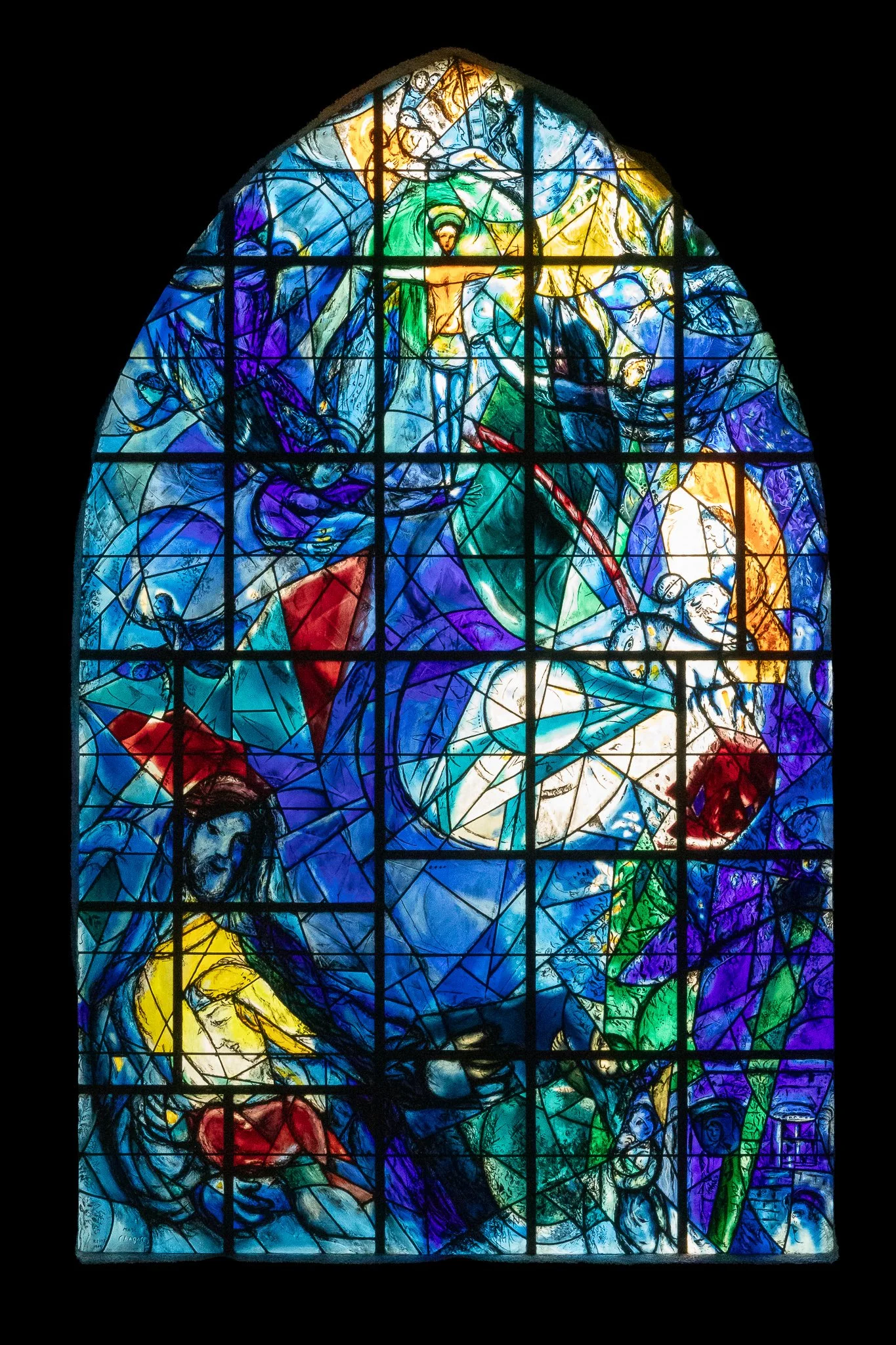
The Good Samaritan by Marc Chagall
Marilyn A. Johnson has published poetry most recently in Pedestal, Plume, Provincetown Journal, UCity Review, and The Westchester Review. Her three non-fiction books include The Dead Beat, about obituary writers; This Books Is Overdue about librarians and archivists in the digital age; and Lives in Ruins, about contemporary archaeologists. She lives with her family in Westchester County and can be found at marilynjohnson.net.