
A Literary Journal
Low Tide Mind
It might be the blur in my vision—but all afternoon I stared into the drought of low tide, watched how the sea pulled back like a child reluctant to say goodbye and left behind a map of something half-formed. An open landscape. A kind of silence made visible.
My mother said we’d only stay a little while. Just long enough to start over. But the longer we remained, the more permanent the pause became. The sea was farther now. Even the air felt scorched of memory.
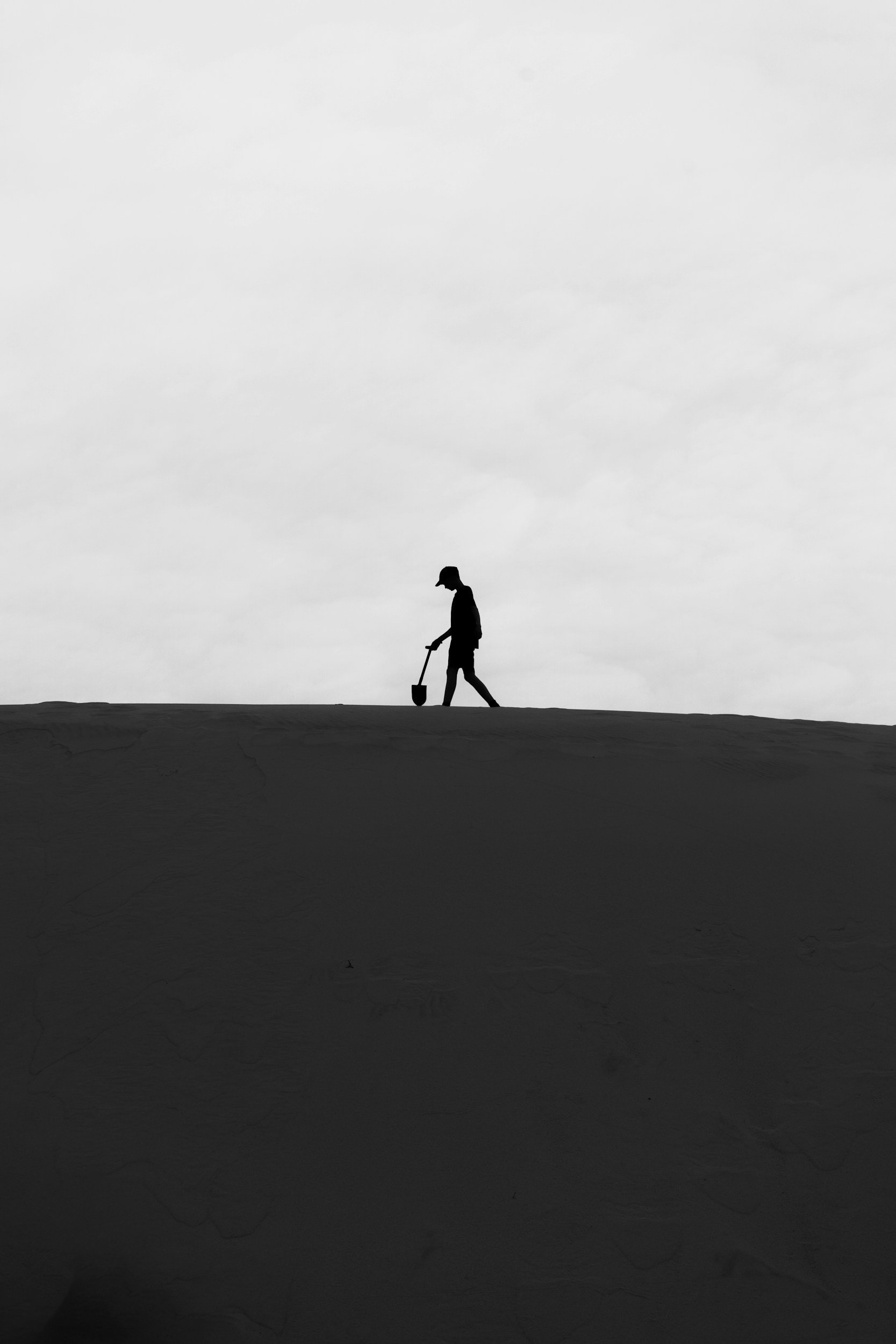
I’d spend hours walking the shoreline—what remained of it—with a metal detector and a second plan. A second hope. Maybe it was the blur in my vision again: I’m always crying. Always thinking I can solve the arid regions of my world by force of feeling, instead of letting the moon handle what she’s always known—how to pull a tide home.
There was a time I thought I could make human life possible here.
If I could find the right canteens buried in the dust of my past. If I catalogued the terrain with the precision of someone who knew thirst intimately—folding the eyelid with its lashes, looking inward to see the shape of the next manifestation.
A soft wind came and leaned into my ear, asked: why are you so desperate?
But I didn’t listen. Not really.
We’d left home after the rain stopped coming and the trees turned skeletal. I remember the sounds: cicadas clicking like broken clocks, the cracked hush of a dry field surrendering its last green breath. My mother, half-packed and unreadable, said it would be better somewhere else.
Somewhere with blinking lights. Somewhere with jobs. Somewhere not haunted.
Words had been said. Dust had been shaken from what was buried.
And maybe walking in this dryness means I’m already standing on top of an invisible ocean.
Could it be that this habit of fleeing—from the fullness between the cracks of my new life—is just the body’s way of sensing too much at once?
I grew up surrounded by nature for so long it became both a gift and a curse. I knew what silence really meant. I knew the sound of wind moving through a hollowed-out pomegranate tree, knew the rhythm of water pushing stones against each other until their edges blurred.
Here, silence is rare and artificial. Here, everything bleeds noise.
What the city calls clarity, I call fracture.
Even the light behaves differently. It travels like a detective, tracing the profiles of things—casting about for shape, tone, something familiar in the fragments. Like the scent of fresh earth after rain. Like the pale undersides of tree trunks. Like the way my mother used to hum while hanging laundry, unaware I was listening.
The frenzy of this new neighborhood struck me at first like a nightmare—brash and blinking. Street numbers like equations I couldn’t solve. Names of corners that gave me headaches, as if I’d fallen into the neural map of a scientist mid-thought. Each name demanded a memory I didn’t yet have.
My mother said I’d adjust. She gripped my hand tight whenever we crossed a street, her other arm out like a barrier between us and the unknown. The crossing lights twitched from orange to red and back again, as though uncertain of their own decisions.
Some afternoons I still pressed one hand over my left ear, like I was listening for the tide.
Like I still wasn’t convinced it was really gone.
There were days I’d walk out past the edge of the city, where the land softened into something closer to memory. I’d bring my metal detector, just in case. There’s something sacred in searching—something ceremonial in the act of trying to find what no longer wants to be found.
Once, I unearthed a rusted spoon. Another time, a key with no door. And once—a bottle cap, smooth as a river stone. I took these things home like talismans. My mother laughed, said I was turning into an archaeologist of the ordinary.
But I knew what I was really doing.
I was mapping the absence. Drawing a coastline with nothing but loss.
At night, I’d dream in salt. Wake with sand between my fingers. Wake with a voice in my head—not my mother’s, but older, lunar: It is not your job to call the water back. It will come. It always does.
Now, I think of the sea less often. Or at least, I no longer expect it to arrive on demand. I’ve begun to suspect that low tide isn’t absence—it’s preparation. The ocean gathering itself. The silence before the symphony begins again.
I keep my findings in a shoebox under my bed. The spoon. The key. The bottle cap. Little anchors in a world that still feels like it’s floating.
Maybe it’s just a matter of time.
I’ll get used to this rhythm—broken by horns, the flashing lights, the thrum of subway trains underfoot. One day I might walk past a street corner and feel nothing. Or everything.
Memory isn’t linear. It’s tidal.
And when it comes back in, it brings not only the old but the newly formed. Things made soft by the journey. Things polished by their return.
MARIE ANNE ARREOLA
Marie Anne Arreola is a bilingual poet and editor whose work appears in journals across the United States, Europe, and Latin America. She is the author of Sparks of the Liberating Spirit Who Trapped Us (Foreshore, UK) and founding editor of VOCES, a bilingual platform for global artists and writers.