
A Literary Journal
Every Painter Is Born Somewhere
On Chagall’s Good Samaritan Stained-Glass Window
Union Church of Pocantico Hills, New York
Commissioned by Rockefeller Family
to Honor John D. Rockefeller
“It’s My Town, Mine, Which I Have Rediscovered”
Marc Chagall, 1918
Moishe Shagal, who lives in the Jewish quarter
of Vitebsk, will transcribe the shtetl, architecture,
and folklore into a mythic dreamscape,
a monument that forever shelters the symbols
of Eastern Jewry, soon to be annihilated by fascism.
Thirty-one onion-domed churches inscribe
the skyline of Chagall’s boyhood. With no
art allowed in his Hasidic home, he remembers
first watching a student sketching as revelation.
Bronx, New York, 2025, August,
4:00 a.m. ICE agents pound on
the apartment door of U.S. citizens—
a teacher with her young children.
ICE agents search for her undocumented
brother who has stayed with her.
Ten masked ICE agents enter with AR-15s.
In 1937, the Nazis seize sixty-three of
Chagall’s paintings deemed degenerate.
He and his wife Bella escape to New York
on the last rescue ship out of France. He teaches
children onboard how to draw.
With no time for her to wake them,
her children stumble out of bed;
ICE agents point
their rifles at the children.
When it comes to English, Chagall
refuses to learn yet another language.
Los Angeles, California, September 2025,
3:30 p.m., another ICE story,
a young boy of Latin
descent walks his dog after school.
Of 170,000, all Vitebsk civilians flee except 16,000,
and in July 1943, the Germans capture the town.
In 1945, the Nazis incinerate all the buildings.
ICE agents wearing ski masks drive up
in an unremarkable car, screech
the brakes, and stop the boy with his dog.
They rip off
the dog’s collar and leash
and kick the dog hard in his belly.
They throw the boy onto the pavement.
While he sobs, they shove him
in their car and drive off.
Only 118 Vitebsk survivors creep out of their cellars
alive. Chagall never returns to his childhood home.
He chooses the blue background for the Good Samaritan
window at the Union Church to symbolize light
and happiness, just as does his favorite Maeterlinck
in The Blue Bird when Mytyl and Tyltyl, poor children
brave demons to search for the bluebird through
the kingdom of the future, the land of memory, and
the palace of night. They search for l’oiseau bleu.
The dog runs desperately
to follow the car into traffic.
Giving the mother no time to wake them,
the New York ICE agents
point their rifles at the children.
They wish for l’oiseau bleu to lead them to the truth
of finding happiness only within, only when they give
to others. Chagall creates the Good Samaritan window—
the priest, the Levite, the soldier, the thief.
ICE agents take the boy
and kick the dog.
Watch ICE point
their rifles at waking children.
An Israelite is beaten and abandoned on the side of the road
to die; the Levite and priest do not help him.
The Samaritan pours wine and oil into the man’s wounds
and carries him on his donkey to shelter at an inn.
The dog runs desperately
into traffic to follow the boy forced into the car.
Giving the mother no time to wake them,
the ICE agents
point their rifles at her children.
_____
Notes
“Every painter is born somewhere,” is attributed to Chagall by many sources, but he apparently never made the statement.
After his arrest by Nazis in 1941, Chagall was supported by Solomon Guggenheim and the Emergency Rescue Committee, funded by John D. Rockefeller and others, who assisted artists and thinkers on the Gestapo’s most-wanted lists in fleeing from the Nazis.
Interview
MQ Which aspect of the Union Church's history, specific window(s), artist biography, or other part of this project attracted your poetic imagination and why?
MTS What particularly interested me about the “Luminations” Windows Poetry Project was the sickening similarity between the persecution of Jews in Chagall’s time and the victimization of Latino and Latina communities during ours. I was also captivated by Chagall’s imagery from Vitebsk and Jewish life—the shtetl scenes overlaid with dream imagery.
Because I chose to concentrate on the Good Samaritan Window, I was interested to find examples of good Samaritan characteristics in Chagall himself, such as when he taught art to children during his escape from the Nazis on the boat to the United States, and in the Rockefellers, who inspired and made possible the creation of the windows themselves.
When I discovered that Chagall and I shared a love for Maurice Maeterlinck’s The Blue Bird, which has a place on my bookshelf from my childhood to this day, I was also struck by the recurrent themes of innocence and wonder in both of those artists’ work.
Just as Chagall’s windows are rooted in spiritual journey and moral awakening, so the children in The Blue Bird searched for happiness, joy, and meaning. Both Maeterlinck and Chagall used radiant color, ethereal light, and a dreamlike atmosphere in their creations. Both Maeterlinck and Chagall used light as a metaphor for truth and revelation.
MQ How did that source material inform the poem you wrote for this project in its shape, style, music, or content?
MTS Over the years, I have written several ekphrastic poems. Receiving an assignment to write about one of the Chagall stained-glass windows was an intriguing ekphrastic challenge, but also a wonderful opportunity. The Chagall windows and Chagall’s life were my primary source materials which I combined with first-hand stories from current friends who had encountered ICE. I worked to create a juxtaposition of the two historical periods and content of the stories to establish the poem’s format.
MQ What surprised or delighted you about the experience?
MTS While we have lived in Sleepy Hollow since the early 80s, and I have previously visited Chagall’s windows at the Union Church, I never had the opportunity or incentive to closely study them and learn about Chagall.
MQ How was it for you to read, and hear others read this work in the church itself? What stood out to you about any shared or divergent approaches?
MTS Since my beginning as a poet in the late 60s, I have not often had the opportunity to work on a project with many poets of different ages and experience on a project such as the “Luminations” Windows Project. What was most interesting to me was to see the varied ways poets interpreted this quest.
MARGO TAFT STEVER
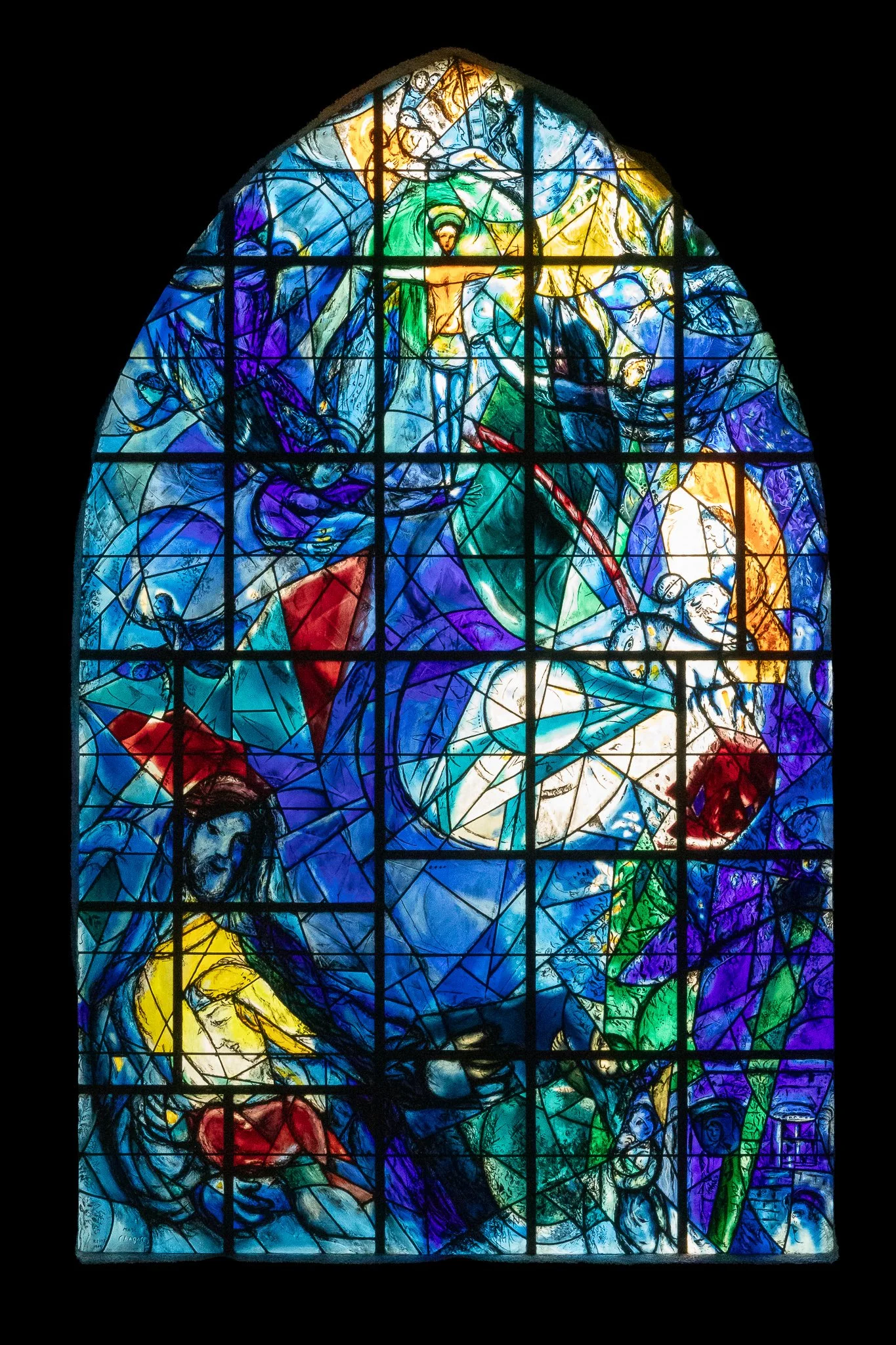
The Good Samaritan by Marc Chagall
Margo Taft Stever’s full length collections include The End of Horses (Broadstone Books, 2022) winner of a 2022 Pinnacle Book Achievement Award; Cracked Piano (CavanKerry Press, 2019) shortlisted with honorable mention for the 2021 Eric Hoffer Award Grand Prize; and Frozen Spring (2002 Mid-List Press First Series Award for Poetry). Her latest chapbook of five chapbooks is Bareback Rider (Broadstone Books, 2025). She is founder of the Hudson Valley Writers Center and currently serves on the board of directors and founder of Slapering Hol Press (SHP) and works as one of three SHP editors (margotaftstever.com).