
A Literary Journal
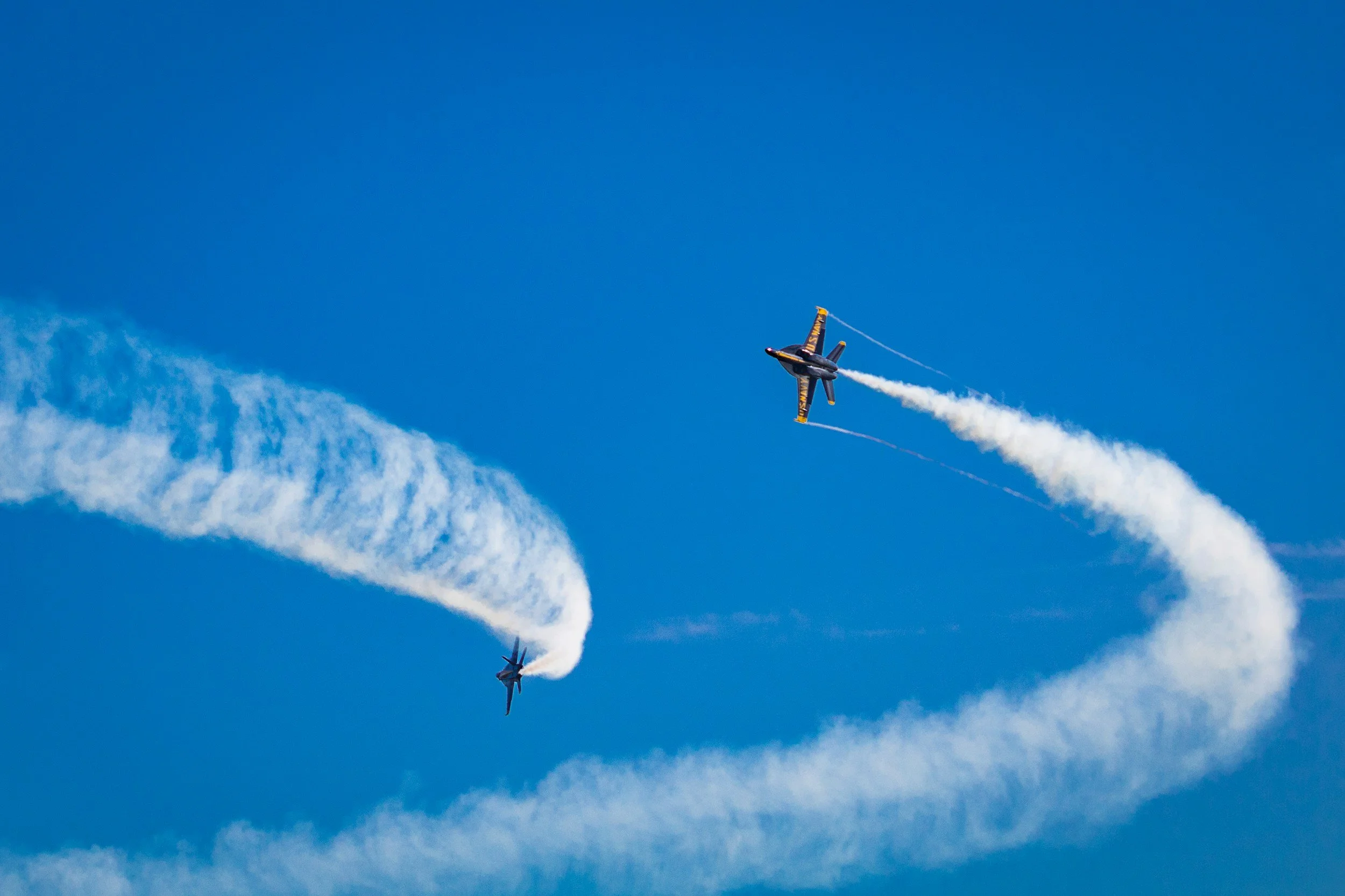
Blue Angels
We unpile from the station wagon in a windy field for another air show.
On the way, my father sings Irish songs he learned from his mother and Air Force anthems the squadron raised in base bars amid a chorus of rowdy toasts. I know them, too, from backseat listening, in a fog of Chesterfield smoke and stories. They are the jingles of my childhood, a way to navigate moods and next stops.
“When Irish eyes are smiling, sure they’ll steal your heart away …”
His eyes—and red hair and sunless skin—are as Irish as can be. He comes from Mulkern stock, from Galway: a mother named Esther, spinster aunts Maizie and Beatrice, and a distant cousin known as Honey Girl, whose photo hangs in Aunt Bea’s house—an Amelia Earhart lookalike, soft brown curls peeking from under her leather aviator cap.
My father’s Irish eyes and heart are happiest at air shows. His place is here: these barren, bleak landscapes that force you to seek reprieve and look skyward. He leans down to pat our heads, lift us up to shoulder position, and point us toward the heavens.
My mother and I wear fringed scarves that wave in the airstream. My brothers hold on to ball caps. My father forgets all about his comb-over as he leans back, looks upward, and catalogs clouds for us: cirrus, cumulus, stratus, nimbus. Another refrain we know well.
He was a navigator-bombardier in the 1950s and 1960s. Top of his class at Syracuse University. Book-smart. But handy, too, good with tools and car engines, woodwork, drawing up designs and maps and helping with school and Scout projects.
“Off we go into the wild blue yonder, climbing high into the sun …”
His friends and family called him “Spike.” It fit. He was tall and lean, with the requisite crew cut, and on weekends, his stubbly cheeks felt prickly when he leaned in for a hug and a whisker rub.
The Blue Angels were saints in our home—actual winged angels who navigated dark skies to protect us from evil, Russia, and nuclear holocaust. We followed them from field to field like rock star groupies, getting a contact high from jet fuel fumes and my father’s boyish pleasure.
We were happy to be in his happy orbit.
We ate hot dogs, posed for pictures, learned the fundamentals of straight-and-level flight, turns, climbs, and descents. We practiced the maneuvers with arms outstretched, zooming circles around and around until we grew dizzy and fell into a chortling heap.
He was the oldest of four, the first son. His first name was after his father. His second, the Catholic middle name, was Gerard, after the patron saint of pregnant women. I imagine a young Esther, far from home, clicking rosary beads and rubbing her belly as delivery day neared.
His family owned a hardware store on the south side of Syracuse, New York. The floor of the store was littered with sawdust and the peanut shells my grandfather tossed after long days of reaching into his pocket for a snack. My mother’s family owned a laundromat two doors down. Her father kenneled his beagles in the back, and they bayed in greeting every morning as the washers spun with soap and bed linens.
My parents aren’t sure when exactly they met, because they always knew of one another, and they knew each other’s others—brothers, sisters, and classmates. They began dating when he was in college and she was working for the telephone company.
He graduated. They married and left South Salina Street to begin the base-to-base trek from Texas to Louisiana, California to Michigan.
“Fly me to the moon and let me play among the stars …”
He loved her, and us, and his days in the air. The altitude and mapping of latitudes. The discipline of navigation, the history and prediction of an aircraft’s path. He enjoyed the camaraderie of men with names like Bud, Gus, and Hank—airmen who were guys’ guys, looking out for one another in the cockpit and base cul-de-sacs.
He loved steep takeoffs, smooth landings, and coming home to the troops who would hug his legs and ask for stories—the made-up kind.
I wonder now if perhaps he landed too soon, retiring early to help run his father’s hardware store and then moving on to careers in banking and business, where the only things that rose were interest rates and his blood pressure. He mapped those, too. And took us to air shows on Saturdays to relax and relive the glory days.
For a while, he stayed in touch with buddies, maintained his military discipline of one-handed push-ups, and pointed out constellations to us on summer nights beside an Adirondack lake.
I’m not sure why he decided to leave something he so obviously loved. Those aren’t questions you think to ask as a child. And he wasn’t one to explain himself.
All you care about then is that he loves you. And what could he possibly love more than the four of us? My beautiful mother as co-pilot, his special girl and two tow-headed wingmen in the back, singing along as we soar highways and back roads, navigating our way through what’s easy and hard, a tailpipe of exhaustion behind and a clear horizon ahead.
And then, many air shows later, you begin to weary of the soundtrack, the stories, the nostalgia for something you never really knew to begin with. You move to the front seat, all brassy and sassy with stories of your own. You roll your eyes and remind him you’ve heard this one before.
You clip the wings of the one who taught you how to fly.
You forget to ask: What was it about flying? How did it make you feel? Why did you stop?
And by the time you wonder and remember to ask, it’s too late. And the unanswered questions are with you on every business-class flight, as you lean into the window (he taught you to always ask for a window seat) and weep into your plastic cup while rose-gold light threads the clouds.
Cirrus, cumulus, stratus, nimbus.
LUCINDA TREW
Lucinda Trew is the author of What Falls to Ground (Charlotte Lit Press, 2025), a meditation on the marvel of gravity and moments of grace. Her work has been honored with four Pushcart Prize nominations, a Best of the Net nomination, and Boulevard 2023 Poetry Contest Award for Emerging Poets.