
A Literary Journal
Eve Comments on Chagall’s Depiction(s) of Herself
After The Cherubim at Union Church and Adam and Eve expelled from Paradise
What to make of my placement, off to the side
watching all the great prophets, and the drowned
man reaching for paradise, and received
by the same Cherubim who drove us out –
I am resigned to be the marker of before and after,
the reminder of how, on the back of a red bird,
we turn away from an ocean of miracles:
from the Pegasus with talon feet, from fishes
with angel wings, from the garden Chagall drew
like a human body bursting with flowers, its face
round as the moon: clear, empty, featureless.
From this happy surplus, my small blue figure reaches out
to pluck the lesser thing—a bit of fruit, a modest bouquet.
There is always something outside the garden to want.
Interview
MQ Which aspect of the Union Church's history, specific window(s), artist biography, or other part of this project attracted your poetic imagination and why?
KW My current book project is a manuscript about Eve, and while I am a non-practicing protestant by birth, I am deeply interested in the more esoteric side of religion and have been moved by Adin Steinsalz’s book on the Kabbalah, The Thirteen Petaled Rose. Lines from this text have found their way into my manuscript, so it was very natural for me to open myself to communion with Chagall’s prophets. I was moved by his mystical depictions of these people in conversation with the divine spirit. I found myself mediating between the relevant chapters of the Old Testament and Chagall’s images, as if I myself were transparent glass, receiving light.
MQ How did that source material inform the poem you wrote for this project in its shape, style, music, or content?
KW The portraits of the prophets are infused with joy. Chagall clearly wanted to communicate his own sense of rapture while creating art. Blue, for him, was the color of love, and blue abounds in the windows. But, in addition, the textures Chagall created by layering paint over the glass completely change the medium of stained glass from what it is in more traditional church windows, like those in the gothic cathedrals. The additional texture infuses each panel with a three-dimensional quality that is almost like the sensation of a caress. What is the message for our outcast Eve, who has a bit part in the windows? I hoped to convey some of what I experienced.
MQ What surprised or delighted you about the experience?
KW Seeing the windows from inside the church, watching the light pour through them, having the opportunity to sit with them and feel them speak, was a gift. None of the reproductions I had seen on-line or in print prepared me for this.
MQ How was it for you to read, and hear others read, this work in the church itself? What stood out to you about any shared or divergent themes or approaches?
KW I was touched the diversity in the poetic response. The world is so much broader and more interesting than one individual can convey, and this becomes apparent when many poets respond to the same impulse. I also appreciated the quality of the listening by all who attended. I am grateful to the Church and to the HVWC for making this event possible.
KATHRYN WELD
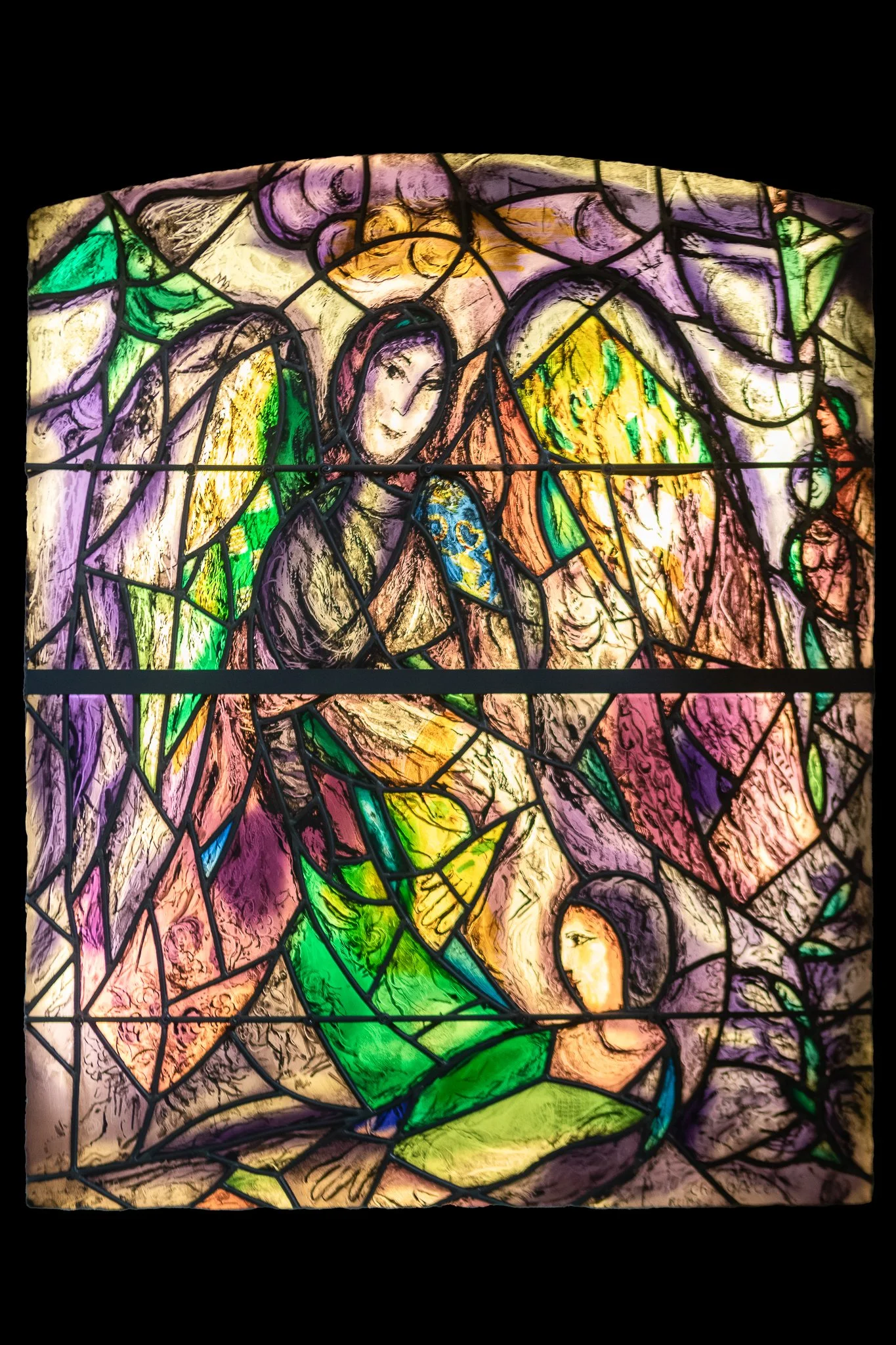
Cherubim by Marc Chagall
Kathryn Weld is the author of AFTERIMAGE (Pine Row Press) and a chapbook, WAKING LIGHT (Kattywompus Press). Her work appears in The American Book Review, The Cortland Review, The Southeast Review, Valparaiso Poetry Review, and elsewhere. A mathematician as well as a poet, find her online at www.kathrynweld.com.