
A Literary Journal
Interview
On February 13, 2026, TWR’s Michael Quattrone sat down with Dominika to discuss the Luminations project.
MQ Hi, Dominika, thank you for spending time with The Westchester Review. Last fall, you created, curated, and participated in an ekphrastic writing project at the Union Church of Pocantico Hills. Some of the poems created for that project are featured in this issue. Would you tell us about that project, the inspiration, and the process?
DW Thanks for having me. I didn’t know that the Union Church had “The Rose Window,” designed by Henri Matisse, which is the last work that he completed before his death, or that it had nine Chagall windows. So this unassuming country church, very close to the Hudson Valley Writers Center, where I'm the program director, it seemed like this was a sacred space, one that should contain poets.
I spoke to Carla DeLandri and Rev. Patricia Calahan, and thanks to them, the church was happy to have us, so I set out to find local poets who would like to participate. We have a lot of excellent local writers, so I just started asking people who I thought would be interested, and lived within driving distance. The poets visited the church from late August through October, and the project culminated in a public reading in the church, among the windows, on November 1.
MQ The poets you invited weren’t only responding to the amazing stained glass windows, but also to the historical information provided by the tour guide from Historic Hudson Valley. So the windows themselves, the place of the church, and the historical context of the commissioned windows all inform the poems that emerged. The reading, as you said, was held in the church itself, surrounded by the stained glass windows that inspired the poems. How was that experience?
DW It felt like a once-in-a-lifetime opportunity to have all of these writers writing together. That aspect of community was really important to me. I’m about to go to Chicago to the Collegiate Arts Association conference with Marion Brown, and we’re going to present this project to art historians, who study buildings and paintings and other forms of art, and also the idea of ekphrasis. It is interesting to me what ekphrasis became during this process, and also during the event.
These were not just poems about the windows themselves; there were so many different approaches that occurred. One was certainly reflecting on the images and the colors that were in front of them, so that's one thing that happened. Another thing that happened is that some of the poems engaged with Chagall and Matisse, their histories as artists, their histories as people, and the historic periods in which they created. Some of the things they faced are the things that we are facing now. Chagall fled persecution and the imminent Holocaust, and was, in fact, on one of the last boats out of France. The coolest thing about this project is that people approached it in a lot of different ways. I never expected it to be that varied.
MQ It was a huge surprise to me too. I was in the audience at the reading, and we were surrounded by those “4,000 / new colors” that you reference in your poem. It felt like being inside a kaleidoscope that was pointed back from the present moment toward the middle of the 20th century, and then beyond to the biblical times of the stories of the prophets that Chagall chose as his subjects.
DW I went to multiple tours with Historic Hudson Valley. They were very gracious in giving the poets tours, and our tour guide, Linda Knapp, was the one who gave us the tours every time. It was a special treat to learn from her about the Rockefeller family and their connection to the windows. All of the windows are dedicated to various members of the Rockefeller family, or people around them, and those dedications and the stories that surrounded them were moving to me. I knew Kathryn Weld because we had worked on a project together. That was my first time actually meeting Phylisha Villanueva in person. We had one of those moments that you just can't relive, surrounded by the windows, and in the presence of Linda and her stories about this history. The three of us are all poets, and we all have different backgrounds that include some difficult things in our lives, and so they all connected. Though I'm a pretty secular person, I guess I would say I’m a spiritual person, too, so I thought about that Bible phrase, “Where Two or Three Gather in My Name, There Am I with Them.”
There was a first-time-ness about this moment, and that's the thing I wanted to capture. The Daniel window was really appealing to me, that coming out of darkness, and it felt like our encounter and our time together was sort of a coming out of darkness, too, so I was very grateful to those two women for sharing that time and space.
MQ I’m struck by the architecture of the poem: three stanzas about three poets, with a title that references the holiness of small gatherings. The three-ness is also reflected in the “yesterday,” “today,” and “tomorrow” named in the poem. “Tomorrow” is conditioned upon that phrase, “if we let them,” and, later, upon escaping the “Rewind. Repeat” of humanity’s baser instincts, as rendered by the pack of coyotes in your poem. With that image, your poem turns. A gathering of predators can be violent, like the violence we are experiencing in our country.
I’m interested in the idea of gathering that is demonstrated in the project, as well as in your poem. Can you say a few words about the importance of gathering right now?
DW Thanks for reading my poem in such a smart and generous way. Most poets don't set out knowing what the poem is going to be, right? We begin with an experience, or an image, or a line, or something like that. I started with the experience of the gathering, but then the thing about the Daniel window that struck me was that there's all this ash and darkness. Daniel is literally rising out of that. I also have a hard time sleeping, so I often worked on this poem at off hours, in the middle of the night, or very early in the morning. I live in a semi-rural area, so I do actually sometimes hear coyotes. That noise, to all of us who have heard it, is so terrifying when they capture prey. So at first, it was the literal: this is what I hear outside of my window. But as I created it, it became a doubling. A metaphorical representation for the violence that I think we're all mired in, that we see, hear, read about, especially starting this January. My desire to foolishly save a rabbit is my desire to save people, even if they're not asking me to do that. The only way that we get through anything difficult on a national level, and on a personal level, too, is by creating partnerships and community.
I am most passionate about how we create community at the Hudson Valley Writers Center. How do we let people know that they're not alone, whether they are in an assisted living facility, or in the middle of a rural county? Maybe they have a computer, and maybe they want to take a writing class.
MQ I want to turn back to your poem for a moment. Because you mentioned working at those liminal hours of the day, and it comes up in the poem, “late or early,” “in and out of these windows,” sitting “in love and grief.” What can you say about equivocation as a poetic strategy?
DW I guess it’s a trick, right? Because it allows you to say, oh, look, this poem is more than one thing. We like things that are multifaceted. I think I do it a lot; it allows me to be a little non-committal. I don’t have to feel one way about it, because I can also show you the second way. I’ve been working on a lot of essays lately, also during liminal hours. I think about it there, because I’m trying to render memories, and have something to say about them.
MQ There’s an intimacy to it, because you are sharing the questions you're asking yourself.
DW That's right.
MQ You recently co-authored a chapbook of poems that are both epistolary and based on nonfiction material. Can you tell us about that?
DW I collaborated with Sarah Grieve on an epistolary chapbook called Dear Charis:, coming out early fall of this year.
In 1937, Edward Weston and Charis Wilson traveled along the West Coast and into Nevada. While he documented the area in photographs, she kept an account of their travels. Weston is well known for photographing nudes in nature, and many of those photographs were of Charis. When she died in her 90s, the New York Times called her Edward Weston's “amanuensis,” as if she was merely his inspiration or scribe!
Sarah Grieve and I found Charis’ journals at the Huntington Library. We would like people to know about Charis—who she was and what she did, and how important she was to a specific cultural and historical period. But also how much her brilliance, her humor, her amazing artistic eye, has transcended historical periods. She's as relevant now as she was in 1937..
MQ I look forward to reading the chapbook. Before we say goodbye, would you like readers of The Westchester Review to know about any upcoming events at the Hudson Valley Writers Center?
DW Local readers might want to check out the annual Westchester Poetry Festival, which we co-sponsor with the Masters School. Kimiko Hahn is our headliner this year, the Poet Laureate of New York State. She will be joined by Lauren Camp, Poet Laureate of New Mexico, Phylisha Villanueva, Poet Laureate of Westchester County, and Samyak Shurtok, winner of the Donald Hall Poetry Prize. The reading will be held at the Masters School on Friday, April 10th at 6:00pm.
I hope virtual audiences keep an eye on the HVWC calendar. We expect to offer an exciting community event in July for the nation’s semiquincentennial.
Where Two or Three Gather in My Name, There Am I with Them
Kathy and Phylisha wander in and out of these windows
with me, we poets three, here we sit in love, and grief.
Amid Chagall’s orbs and birds and angel after angel
painted, smudged, hammered and fired. He invented 4,000
new colors that belong to us all every time we see them,
as they have yesterday, and will tomorrow, if we let them.
We’ve got to flood the zone with this, I say, because the world here
and far away is on fire. Lord, that fire is hot and hungry
and leaves us burnt to bits, ashes for robes. And I am Daniel
today, before that flight with arms outstretched, before that leap—
of course—of faith. Those robes suit me, that black a chic armor.
Lately nothing gets in or out, except for all that doubt and sadness.
Outside my own window, it is late—or early—and the coyotes
have lured their prey and yowl their delight. I know they came
in a pack, cut off the exits, all teeth and fur and heavy breath.
It’s instinct, and of course they should kill and eat, kill and eat.
Rewind. Repeat. But is it terrible to say I don’t want
them to? That I want to find that rabbit, and save it?
DOMINIKA WROZYNSKI
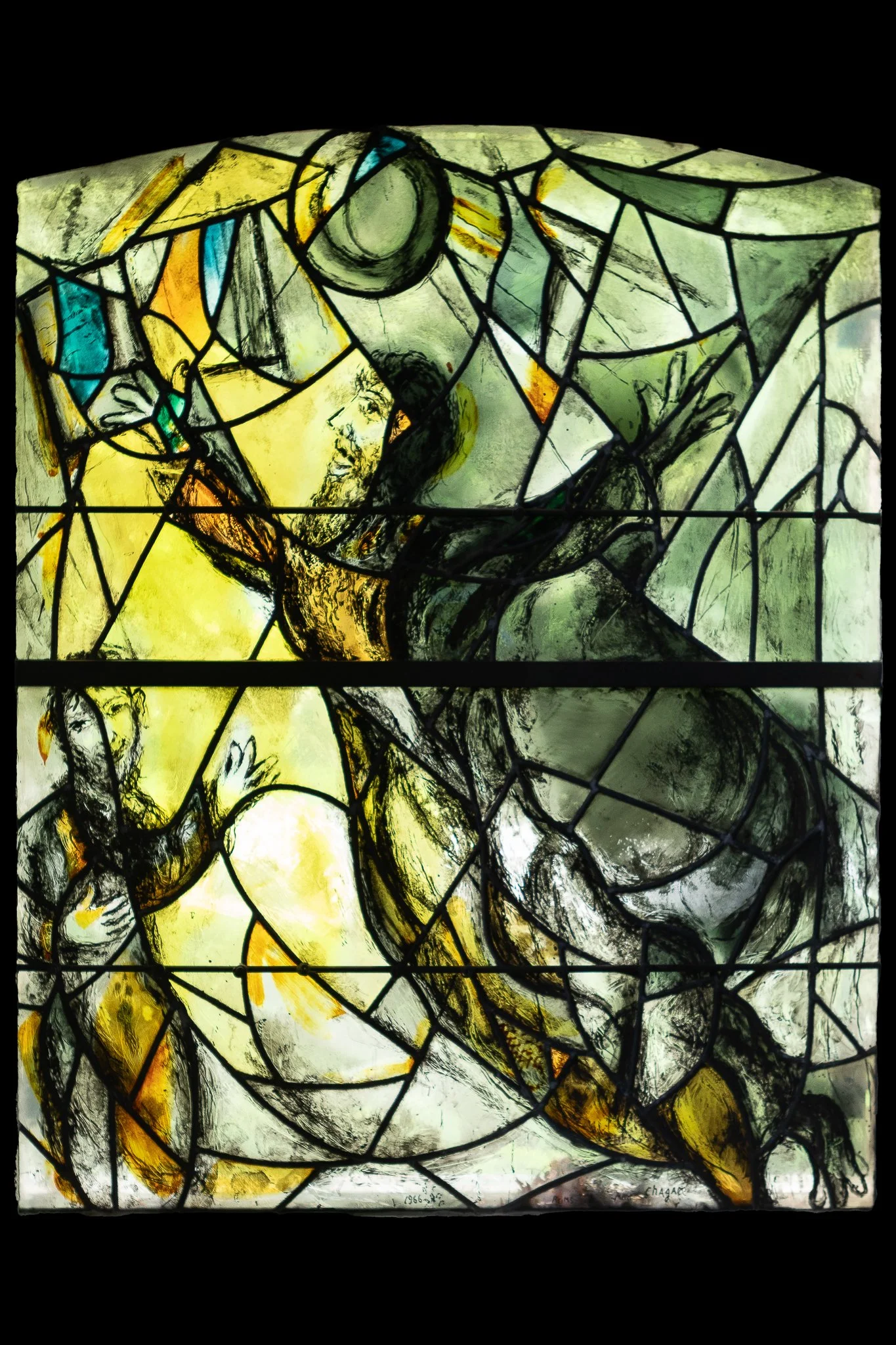
Daniel by Marc Chagall
Dominika Wrozynski is the Program Director of the Hudson Valley Writers Center and author of American Accent, winner of the Sinclair Poetry Prize from Evening Street Press. She is also the author of Dear Charis:, a chapbook co-authored with Sarah Grieve (forthcoming in August 2026). For 22 years, she has taught creative writing and literature. Her poems have appeared in journals such as Crab Orchard Review, The Spoon River Poetry Review, Rattle, Five Points, Nimrod, Birmingham Poetry Review, New Madrid, and many others.