
A Literary Journal
Great White Nothing
Mitra was striding fast up the hill away from her front door. She was fleeing a hot flash of claustrophobia. Really fleeing, actually running from it.
She had been on the sofa with Daniel like always, laptop burning her thighs as she fiddled around in Photoshop. Wasting her night on a UI element no one would ever really look at, when a terrifying siren began to go off inside her.
DANGER, DANGER.
She couldn’t take one more second of being surrounded by so much tedious familiarity.
She had stuffed in her earbuds, shoved the laptop to the floor, and taken off, waving goodbye to a confused Daniel through the living room window.
* * *
Deep in the cavity of her ear, a familiar nasal voice, an announcer on a favorite NPR program, was droning on about artist residencies. How someone else might foot the bill for you, just to travel and sleep in a dorm and write or paint or whatever else it was you did.
“Did you know,” said the nasal NPR man, “that they’ll even send you to Antarctica? Today on our program, we spoke to Laurie McCoy, a painter who went on an artist residency and ended up living there for two years.”
“Thanks for having me,” Laurie McCoy’s voice intoned, soft and whispery, the kind of voice you’d expect from a painter who did artist residencies.
Mitra was an artist.
Sort of.
She did graphic design for a software company, but she had gone to art school. She still messed about sometimes with gouache and canvas and palette knives, just to feel like she hadn’t lost all sense of the woman she’d dreamed of becoming in all that making of blobby, primary-colored people with no discernible features for software tutorials.
She tuned back in, listened to the final beats of the story as Laurie McHoy got in her last words.
“It was a life-changing experience,” Laurie said in her tremulous whisper. “Truly awe-inspiring. Like nothing I had ever done before. The frozen world is an alien place.”
That was what Mitra needed.
Life change.
The nasal host returned.
“If you’re thinking of following Laurie’s lead and spending a few months in the tundra, you can apply with the Antarctica Project. Oh, and invest in warm socks. Laurie says she didn’t, and she wound up wearing every pair of socks she’d brought with her. All at the same time.”
At home, Mitra retrieved her computer and started researching the warmest socks available for purchase.
“Are you okay?” Daniel approached her cautiously at the kitchen table. She hardly looked at him, opening tab after tab of sock reviews.
“Yeah,” she said.
“What you lookin’ at?” he asked, rounding the table to peer over her shoulder at her laptop.
“Socks,” she said.
“Huh,” he said. “All right, then.”
And he wandered off. She heard the sounds of him sitting on the sofa, queueing up a history documentary, talking to their lazy old dog, Otter. Mortars and grenades launched, tinny radio clips played. She wondered what there could possibly be left to learn about World War II, and then she went back to the socks.
She purchased fourteen pairs. Enough to go two weeks without washing them. And then she went to the Antarctica Project website and began filling out an application. She added PDFs of the paintings she had done in college, her last really good ones, just after she met Daniel. A lush orchid, the velvety texture of the interior petals just right, the perfect shade of mauve. A painting of snow melting on the steps of her parents’ house in Michigan. To show them that she had some idea of what she’d do with her time there.
She didn’t wonder if she’d get in. Surely the universe had delivered this information to her at this time, in this moment, because it was the path she was supposed to take.
* * *
Six weeks later, they were at their usual diner, eating breakfast on a sticky tabletop.
“Working on the weekend?”
She stared down at the message in disbelief, even though she had known it would happen. She hadn’t told Daniel yet.
“No,” she said. “Actually, it’s personal.”
“Oh?” he said. “Is everything okay?”
“Everything’s great,” she said, and she melted into sobs. “This is so crazy, you’re not going to believe this.”
Daniel lifted his mimosa to his lips, a half-bemused, half-frightened look in his eyes.
“I applied for an artist residency.”
“Baby,” he said. “That’s great! You thinking about picking up art?”
“I got in.”
“Mitra! This calls for a celebration.”
“Don’t you want to hear where I’m going?”
“Where? Taos?”
She shook her head, laughed through the still-falling tears.
“Antarctica.”
Daniel’s red-blond brows furrowed, the freckles along the bridge of his scrunched nose becoming one great light-brown mass.
“Come again?” he said.
“Antarctica.”
“You’re going to Antarctica? You, who keep our house at 75 degrees in the winter and still wear a sweater?”
“I am.”
He didn’t seem to know what to do with his face, the two halves of it at war. His mouth smiled; his eyes and brow grew slack, a little watery.
“You didn’t even tell me you were applying. How long are you going for?”
“A month,” she said.
“The socks,” he said. “That’s what the socks were about.”
She laughed and nodded. “I hear the cold is particularly hard on the toes.”
* * *
When her various online purchases started coming in the mail, Daniel would bring in the packages from the doorstep and watch as she unwrapped things for the trip—the traitorous socks, thickly insulated gloves, binoculars, waterproof pants, hand warmers. His voice giddy with disbelief, he would say, “You’re actually doing this.” As if he’d thought she might back down, decide not to go.
“Yup,” she would reply, throwing away the plastic wrapping, popping the “p” with relish.
* * *
The morning she left, she saw him struggling not to cry.
“I can’t believe you’re really leaving for a month,” Daniel said, pulling her into a tight embrace. “I’ll miss you so much.”
“It will go by in an instant,” she replied, and then he’d parked the silver Civic at the airport curb, hazard lights flashing, as he helped her retrieve her luggage from the trunk.
* * *
To get to Antarctica from Phoenix took the better part of three days. First, you had to fly from Phoenix to Atlanta. Then Atlanta to Santiago. Then Santiago to another, smaller city in Chile called Punta Arenas. Then a two-hour flight to King George Island. Finally, a ship from King George Island to McMurdo Station at the southernmost tip of the Ross Islands.
* * *
The whole journey was bizarre, surreal, like moving a numb limb. It wasn’t until boarding the ship that what she had done finally hit her. The air was frigid, the tips of her fingers throbbing with cold. She slid on her thick new gloves and tried not to think of Daniel and Otter on the couch, both snoring as a World War II documentary played in the background.
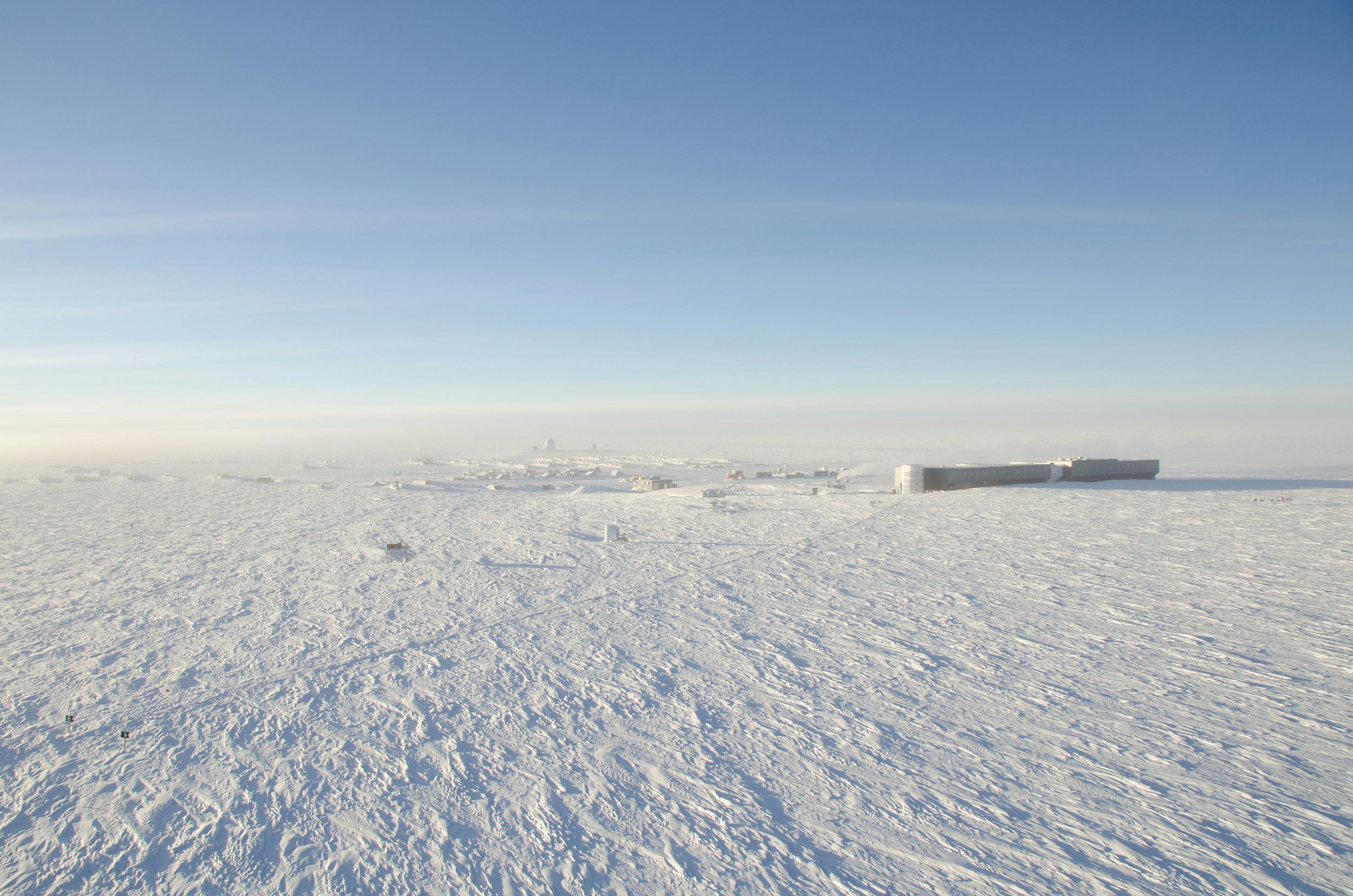
She watched through clouded windows as the ship slowed to a halt amid the floes of ice, and human hands tethered it to a few small poles beside a landing strip of asphalt. When she walked gingerly down the already ice-slick ramp, she was surprised to find not a sea of vast, white emptiness as she’d imagined but a tiny, dirty city. Clusters of shipping containers filled with gravel dotted a vast parking lot, and obscured human figures operated heavy machinery. The motion and business of the bodies was so constant that two of them, standing still, stood out to her—a pair bundled up, faces barely visible, thick layers concealing the outlines of their bodies so that she could not guess whether they were men or women. They held a sign, marker on poster board like a science fair project, that bore her name. She shuffled over slowly, still unsteady on the slick surface of the ice.
“You must be Mitra!” the voice of the smaller figure shouted when she was about twenty feet away.
“I’m Peggy,” said the larger figure, “And this is Lou. We thought we’d show you around camp, if that’s all right with you.”
The old Mitra wanted to say no. She had spent the past seventy-two hours on a plane, on a boat, stuffed into horribly uncomfortable seats, surrounded by other people. She just wanted to be alone somewhere soft.
“Sure,” she chirped. New Mitra had a voice that was not quite her own.
“How was the trip?” asked Lou, the smaller body.
“Long,” Mitra said with a laugh.
“Did you come the New Zealand way or the South America way?” asked Peggy. Mitra trailed the pair of bundled bodies as they walked towards a bright-yellow vehicle, a sort of golf cart with snow treads onto which they helped Mitra toss her bags before they climbed in.
“South America,” said Mitra.
“Oh,” said Lou, “Way worse. New Zealand you can get by with just one flight and then the boat.”
Mitra wished someone had told her that weeks ago. She clung to the pole at the back of the snow golf cart as they took off toward buildings in the distance.
Peggy and Lou went on talking, the wind whipping violently and carrying off their voices before Mitra could make sense of them, the specific shapes of the words drowned out in the screeching whistle.
When they came to a stop in front of a large, low building, Mitra’s head was spinning.
“Is it always this windy?” she asked.
“Yes,” said Peggy. As if Mitra was supposed to know that already.
It was one thing to read about it, another to hear it whistling past you like a bottle rocket. She’d never felt wind like this, couldn’t conceive of it fully when the website declared it “gusty.” Gusty sounded silly, folksy. This was extreme, as if the wind were trying to blow you off the face of the earth.
In the cafeteria, a room that looked shockingly, almost suspiciously, like the one in which Mitra had eaten peanut butter sandwiches in middle school, Peggy and Lou shed their many layers like snakes, dropping them one by one onto hooks near the door. Without their insulation, they seemed to shrink to half their size—both tiny in different ways. Peggy was short with an iron gray bob and smart little glasses, Lou tall and thin as a sapling with sun-leathered skin that crinkled around the eyes. The three of them got in line, Mitra at the end, sliding bright-colored plastic trays down counters comprised of metal poles as people on the other side handed them bowls of soup, large slices of brown bread, a vaguely dessert-like pile of apple and pale pie crust. As they went along, the slight scraping of the tray sent shivers down Mitra’s spine. She felt so vulnerable, so strange. As if the travel and the climate and the newness of it all had rendered her newborn, tender, soft-skulled, and on the verge of wailing.
They sat at a round plastic table and ate the soup, dipped the bread, exchanged pleasantries and abbreviated life stories. Peggy was a biologist, investigating the Antarctic biome, Lou an artist who had spent their life chasing the cold, painting arctic landscapes in watercolor, scene after scene of glaciers and snow put to canvas with freezing fingers. Mitra was a painter too, she told them, one who had come to Antarctica looking for inspiration.
“Ice is incredible,” said Lou. “It contains every color you can see with the naked eye.”
To Mitra, the land they’d passed had just looked white.
When the table was cleared of empty soup bowls and pale flakes of bread crust, Mitra and Lou returned to the hazard-yellow golf cart, crawling across the vast expanse of whiteness—already it was different, the sun beginning to set, the ice glowing the hot orange of a campfire—toward another low sprawl of industrial buildings, metal-sided and featureless.
“Welcome home,” said Lou, opening the door to reveal a sort of army barracks, endless rows of metal beds that stretched from wall to wall, each topped with a set of thick, nubby gray blankets. Mitra wondered how Lou knew which bed was meant to be hers, how they could pick it out of the sea of identical beds in identical neat rows.
“Get some rest,” said Lou, patting the center of the bed in a gesture that felt to Mitra like trespassing. “We’ll see you bright and early tomorrow.”
“Should I set an alarm?”
Lou smiled, the corners of their tanned eyes revealing deep, worn crevices. “No need. The reveille should wake you right up.”
Mitra dropped her bags beside the bed and slipped off her boots as Lou walked away. She had brought warm pajamas, a thick, fleece number that enclosed her toes and could even be zipped to cover her hands like mittens. Inside the barracks, it was far warmer than the Antarctic air, but still she could not imagine baring her skin to the chill of it. She removed the outermost layer of the coat and fell asleep with her clothes on.
* * *
Morning.
A bright brass horn played from the end of the barracks and Mitra shot up in bed, looking angrily for the sadist who would do such a thing. The sadist was Lou, gloved fingers wrapped around the featureless curves of a bugle. Many of her fellow sleepers—bunkmates? Is that what you would call them?—were already dressed and mobilized at the door. The air was throbbing with cold. After a surreptitious sniff about the armpits, Mitra stood, wearing the clothes from the night before, and joined the line of people trudging outside, toward the cafeteria.
She had never felt more like an ant than she did in this moment, marching in a line of bundled humans, all headed for the same destination, the same hunk of cake from which they might retrieve their crumbs and carry them back to their anthill. It was a pleasant feeling, the impersonality of it.
When she had retrieved her breakfast (a bowl of steaming oatmeal, coffee, fruit) from the slow cafeteria line, she looked around the plastic tables full of unfamiliar figures, and the middle-school feeling, the nauseated heartburn that belied a desperation for a sense of belonging, rose right back up in Mitra’s throat.
The old Mitra would have sat sheepishly at an empty table, speaking to no one, perhaps even retreating to the barracks with her tray to eat breakfast alone in bed. The new Mitra boldly strode toward a table of younger-looking people, mostly men with beards and bright-red cheeks.
She set down her tray with a clatter of plastic.
“Hi,” she said. “Can I sit here?”
“Sure thing,” said a man with a blond crew cut, the tip of his nose pink and upturned.
“I’m Mitra,” she said.
“You here to write about the ice or somethin’, Mitra?” asked Crew Cut.
“I’m a painter,” she said. And then, “How could you tell?”
They all laughed. “You don’t look like you’re here to do hard labor.”
Her face burned, a heady mixture of shame and pride. She looked like what she was. Some artistic Other. Some citified fool, here seeking profundity.
“You caught me,” she said, taking a sip of watery coffee.
“They usually keep to themselves,” Crew Cut offered. “The artists in residence.” He gestured toward a table Mitra wished, with a pang, she had noticed before. Men and women with fair skin, all looking around nervously or noses deep in notebooks, their hands distinctly unchapped, the skin of their palms smooth and pink.
The people at her table wolfed down their breakfasts, shoved back quickly from their chairs.
“Work to do,” said Crew Cut, lifting a hand as they walked away, leaving Mitra alone with the dregs of her oatmeal.
Then it was time for the first day of painting, out there in the cold.
The thing that surprised her most about the ice was not the thing that had moved Lou, the vast spectrum of color that could be found within the deceptive whiteness. It was the sound. In her Michigan childhood, Mitra remembered snow as almost terrifyingly silent, the thick blanket of it absorbing the noises of the world around it so that all seemed quiet and still. This ice was alive, eternally popping and creaking, separating, like the sound of a blazing wood fire.
Mitra sat with a pencil in hand, staring at her sketchbook, freezing into position like a statue. Draw something, she thought. Get an idea. By the end of the first day, she had a cramp in the center of her brain, like a foot in a too-tight shoe, and one shitty sketch of a glacier. She had forgotten that art was like this.
The second day, Mitra found a spot protected from the gusts of wind by one of the long, low barracks. One of the women she’d seen at the artists’ table the day before, all but the distant gray sparkle of her eyes covered by layers of scarf and balaclava, sat on a bench with pencil in hand, the noise of her scribbling swallowed up by the chaos of the ice-sound. Mitra raised a bulbous gloved paw at her. The woman refused to catch her eye.
No.
The old Mitra was always projecting malicious intent, putting her own self-hatred into the mouths, the gazes of others.
The new Mitra would think generously.
Perhaps the woman could not see Mitra, the dazzling white reflection of the ice obscuring her view. Mitra rose and crossed the gap between them, still holding up one gloved hand. When she was close enough that she knew the woman must have seen her, she smiled widely.
“Hello,” she shouted.
Look at her. Doing this. Being friendly.
The wind snatched the woman writer’s voice.
Mitra strode closer. Said, “I’m sorry?” practically into the woman’s face.
“I came out here to be alone,” the woman said.
“Oh,” said Mitra. She scurried away like the cockroach she was.
The next day, it felt all right to be alone. There was so much to process, she told herself. She went to bed that night without having said a word to anyone since breakfast.
On the fourth day, at dinner, she looked around the cafeteria, tray in hand, and walked over, her heart pounding wildly, toward the table full of artists Crew Cut had pointed out that first morning. The woman who had wanted her solitude sat across from the empty chair. Mitra smiled nervously at her, baring her teeth like some quivering toy dog, readying herself for their curiosity. What should she say, when asked about herself? It occurred to her the freedom that existed in this new environment. She was not bound to her true history, to Daniel and Otter and graphic design and Michigan.
She sat with the other smooth-handed artists. She waited.
They chewed their stroganoff in silence for a long time. Mitra took out a sketch pad and drew. Daniel and Otter on the couch, snoring in matching poses of slack jawed repose. Revealing herself anyway, if anyone cared to look.
The fifth day on the ice, she stopped squeezing. Stopped straining for ideas. She just let herself float inside her brain, to think whatever thoughts came to mind. Most of them were about her toes and how much they hurt before they went numb. For the first hour, she composed a review in her head, all the powerful words she would use to describe her loathing of the socks. How the sock company’s grandiose false promises had put her in this miserable situation.
Somewhere in the space of the third or fourth paragraph she’d memorized about the socks, her hand began to move across the page. To sketch the jagged edges of a glacier, like savage teeth that rose up from the water. The sun moved in the sky, and she saw what Lou saw. A rainbow dancing on top of the ice. Tomorrow, perhaps, she would try to capture the color, the way it made her feel, like a bubble rising up to burst at the surface of her chest, just near her heart.
The next morning, she was up before the reveille, the first out of the barracks and into the mess hall.
* * *
Each day began to pass the same way.
She sat on the ice with her pastels and watched the colors shift. It felt pure. Like some sort of pilgrimage, some prayer-in-action, some bizarre form of worship.
At night she wrote in her journal. She learned where hot water could be had for tea. She got into her bunk while the lights were still on, and she wrote poems. Sometimes she just looked at the steam rising up from the tea in her metal cup, and that felt like praying, too.
Once, she had dinner again with Peggy and Lou.
“How are you finding it out there?” Peggy asked.
“Cold,” said Mitra.
“But really,” said Lou.
“Oh,” said Mitra. “You were right about the colors.”
Lou smiled, fork deep in a pit of mashed potatoes. “Once you open yourself up to seeing. Not looking, you know, but seeing . . .”
Mitra nodded vehemently. “It took me a few days,” she admitted. “To stop looking so hard.”
“And that’s when you started to see,” said Lou.
In the great, warm nothing of this conversation, she felt understood.
The big hiccup of panic in Mitra’s chest, the feeling like heartburn-but-all-the-time, had begun to ebb. She didn’t connect to the other artists, or to anyone really, not like she’d wanted to. She was lonely, and she wasn’t lonely at all. She felt, maybe for the first time in her life, the presence of something bigger than herself, all around her. In the ice and in the air and in the oatmeal. Maybe she hadn’t made room for other people around her because on some intuitive level, she knew she needed the space for this presence—God or self-actualization or whatever it was she was sensing.
The night before she left, she was in a towel outside the showers, watching the heat rise off her skin in plumes of steam that breathed out and up into the cold air. She stood before the fogged-up mirror, the new Mitra. The tile felt solid beneath her feet. She was at the end of some grand metamorphosis, emerging from the squashy, thick layers of her Antarctic wardrobe a new creature. She could not wait for Daniel to see, to witness New Mitra and, in doing so, prove to her that the change was real.
On the last day, she cried in bed, listening to the last reveille she’d ever hear from Lou’s lips. She erased all evidence of herself from the barracks, from the cafeteria.
At breakfast, she sat with Lou again. They hugged awkwardly, Mitra barely feeling the embrace through her endless layers of insulation.
There was no one else to say goodbye to, except the ice. She pressed a gloved hand to it, patted it like a faithful horse. Goodbye, she said from inside herself. Goodbye, big feeling. Goodbye, once in a lifetime.
* * *
Then she got on the ship and watched it slide away. The quiet, the stillness, the white that contained every color slid away with it, replaced by the cacophony of machines and the dreary gray of the sky. The silent crackle of the ice gave way to the rumble-slosh of choppy water. The crisp, icy air was dank and close, redolent with the mild stink of mildew and bleach. She had forgotten the feeling of being in a body, amid all the cold and quiet and the endless routine. She had become a pair of fingers clutching a pencil, a lump among the piles and piles of blankets on her bed. The return of sensory stimulus crashed over her in sickening waves.
Mitra braced herself against the wet wood beneath her, wrapped two mittened hands around the metal poles, and pushed hard, trying to root herself in place. The boat was sparsely populated, but she could see, on the faces of the other passengers spread out across the cabin, the same inner greenness she felt. She closed her eyes and turned her face toward the lights on the ceiling, watched the red-green fluorescence of her veins behind her eyelids, and tried to breathe deeply.
* * *
When it was over, hours upon hours of merciless tossing and turning and bracing and breathing, she staggered to the dock, pack in hand, and walked stiff-legged toward the first tiny airport. The first time she had been here, she was awed by the quiet and peace of the place. There were tiny electric fireplaces amid the clusters of seats around the two gates. Airports, in Mitra’s experience, were these hubs of chaos, of irritation and eighteen-dollar bagels, endless loudspeaker announcements, and wailing children. But now, on the other side of this Experience, even this place was almost overwhelming.
* * *
She missed the ice like home. Like her mother, the day she moved away for college.
* * *
Sitting at the gate, she tried to write it all down—the thoughts that bubbled and screamed like a kettle boiling, all the things she’d experienced. Not even halfway home, just a few thousand miles from the birthplace of the new Mitra, her worst fears were coming true.
It—she—had already begun to fade away.
* * *
How could she tell Daniel, if she couldn’t put it into words? How could she make him understand? The sounds of the ice, the feeling as if she’d dry-cleaned her soul. She wrote them in the notebook she’d half-filled and stared down at the spikes of her own handwriting, struck by the ugliness of it. The words on the page. The grief they brought up for an experience she’d only just left behind.
* * *
Finally, she boarded the first plane. Then the second. The third. The fourth.
* * *
As she was borne further and further away from the site of its birth, she could feel the new perspective, the muchness of it, fading from within her. She tried desperately to focus on the bright white feeling inside of her, flexing and flexing, spiritual kegels in cramped coach seats.
Remember what this feels like, she said to herself.
This inner muscle, this decision to be new.
Remember and use it and hold this experience in your heart.
Please, God.
Please, Mitra.
Let it have meant something.
* * *
But in the silver Civic, they waited in traffic, a road closure adding twenty-five minutes to their journey home. Everything annoyed her, set her on edge. The plink-plink of the blinker. The cars that snuck in front of them as they made their way to their exit. The weakness of the wind, the stale heat of it, passing feebly through the open car window. She tried to count the colors of the sunset, grew frustrated at even that.
In Daniel’s arms that night, the boiling-over-with-words feeling she’d had made way for something new. She could not decipher where it came from: anger at herself for finding at home the same feeling she’d had when she left? Anger at Daniel, for existing in the same way he always had? She threw off the covers, writhing and sweating, suffocated by the heat of Daniel’s body.
The next morning, they returned to their routine. They let Otter out into the front yard. They went to the diner. They sat at the booth in the corner. Daniel ordered the same thing he always did. When the waitress came to check on them he said “I hated it” with a laugh as he handed her his spotless plate.
All of it made her furious, quaking with a sort of bone-deep anger so intense she could hear the grinding of her teeth.
She was supposed to have changed. The going and sitting in the snow for thirty days, the cold plunge of the spirit she’d taken, it was supposed to fix something inside her.
It hadn’t.
Or it had, maybe. Just not in the ways she wanted.
After breakfast, Mitra went for a bike ride alone. When she came back, she shed her sweaty clothes and climbed into the bath. In the hot water, all she could think about was her toes. How good it felt to feel them at all. In the midst of her great breath of relief, her meditative awareness of her toes, Daniel’s knuckles sounded against the door.
“Can I come in?” he said.
There was no reason she shouldn’t want him to. She didn’t want him to.
“Sure,” she said.
He sat, as he always did, on the closed lid of the toilet.
“So,” he said. “Tell me more about it.”
She described the sound of the ice creaking and breathing. The vast whiteness that glowed blue and orange and purple and silver as a mirror.
“Did you make any friends?” he asked.
“Not really,” she said.
“Were the socks warm?”
She told him about the scathing review she’d composed in her head on the second day. About the feeling in her toes and how she’d forgotten it until she got home. Until this moment in the bath.
“Did you miss me?”
She told him about the drawing of him and Otter she’d made on the first night. How much it soothed her to imagine the scene. The nubby feeling of the couch fabric, the comforting stench of Otter’s doggy breath.
“Did you think about God at all, out there?” he said, and he was laughing. “Have any grand ideas about life, the universe, and everything in it?”
Didn’t he understand how selfish he was being, peppering her with questions like this? She needed something, some profound insight she did not have to reveal, some dark or bright corner of her soul she did not have to make known. She began to cry: fat, stupid tears of anger that rolled down her cheeks, slow and sticky through the sweat on her skin.
She looked in the mirror of him and saw the old Mitra. The version of her whose misery was vast as a planet, pulling him in with a force like gravity. She saw him spot the tears, saw him look down at his hands in his lap. Saw him give up, life spilling out of him like bathwater down the drain.
“I’ll leave you alone,” he said finally, rising from the toilet lid with sagging shoulders.
Good, she thought. That was what she wanted.
She looked into the thick white foam of soap bubbles and tried to see the colors trapped inside.
CASEY CLOUGH
Casey Clough won the UCLA Kirkwood Prize in 2024. Her fiction has appeared in JAKE and The Dead Mule School of Southern Literature.