
A Literary Journal
I Beg You, Listen
We search for a prophet in our age of catastrophe. Will he be named Ezekiel?
Or Elijah? Will he be named Daniel?
There are lion’s dens in the unmarked cars of ICE and in the courts.
How will we find them, how will we hear them?
If you listen, you will hear the prophecy of a Mexican immigrant laboring in the orange groves
of Tropicana, he speaks to us of corporate gluttony, insatiable greed.
If you listen, you will hear the prophecy of a nursing home worker emptying bed pans
for nine dollars an hour, she speaks to us about slavery, the minimum wage kind.
If you listen, you will hear the prophecy of a young Black man living the best years of his life
behind prison walls, he speaks to us of a future with no second chances.
If you listen, you will hear the prophecy of a mother afraid to cook with tap water
from her sink, she speaks to us of toxic lakes and sluggish streams.
If you listen, you will hear the prophecy of a Detroit factory worker, his job lost, his shame chased down by whiskey, he speaks to us of young, able-bodied men dead before their time.
If you listen, you will hear the prophecy of a third-grade girl who sees gunmen in her dreams, she speaks to us of her classroom walls splattered with blood.
I beg you, listen, hear the prophecy of a hip hop artist at 125th & Broadway,
he raps about racism, wreckage and redemption, do not be fooled by his use of rhyme.
Interview
MQ Which aspect of the Union Church's history, specific window(s), artist biography, or other part of this project attracted your poetic imagination and why?
AB I did not write about the window that most attracted me—the Rose Window by Matisse. However, it was that window that I could not stop looking at, and kept referring back to, as I took notes on the other windows and began to formulate my poems. It became a source; a source of beauty, of solace, of inspiration. I kept thinking of Matisse, sick and bedridden, creating the maquette for this window during the last days of his life. I imagined that it was for him a portal through which to view “the other side,” or perhaps a doorway for him to step through to enter the next stage of his being. That window is life giving—I see the green shapes as bulbs waiting to be planted—an animating piece of art that creates the conditions for the other windows by Chagall, for weekly worship by the congregation, and my poems.
MQ How did that source material inform the poem you wrote for this project in its shape, style, music, or content?
AB The idea that the Rose Window is an invitation to or an opening into another world—that is, the future which we cannot see—forms the perfect bridge for series of windows about the lives of the prophets who tried to address the moral crises of their time and guide the masses in a direction that would restore moral order. In this troubled and dark time in the life of our country, the opportunity to think about the work of the prophets in creating a better world had special resonance for me. My poem invokes a range of contemporary prophets who most people might not think of as bearing wisdom for our future. It employs a kind of call and response structure with repeating phrases in which the poet writes the call and the reader provides the response, although we do not know if that call will be heeded, creating both a sense of tension and possibility.
MQ What surprised or delighted you about the experience?
AB I was delighted by the colors these artists used. There is a spare elegance, and a deceiving simplicity, in Matisse’s choice to use yellow, green and blue for a memorial. These colors perhaps represent the sun, the earth and the sky, all generative and life affirming choices. But it is the use of white, especially the circle in the middle, that holds the disparate pieces together in a statement of simplicity, peace and holiness. The use of every imaginable hue of blue in the Chagall windows I found inspiring, so much so that I wrote a poem about all the different blues I could think of. “Navy blue/Powder blue/Once in a blue moon….” And more!
MQ How was it for you to read, and hear others read, this work in the church itself? What stood out to you about any shared or divergent themes or approaches?
AB I thought the event was very beautiful and loved hearing the poems of other poets. The size of the church is quite small and intimate, yet the windows create a feeling of vast openness to the world beyond the stone walls. I felt the words of the other poets spoke both to the experience of earth as we know it—exquisite, flawed and fragile—and to a timeless world of spirit and transcendence we do not yet know. And isn’t that one of the jobs of the poet to navigate the terrain between the finite and the infinite?
ANN BOOKMAN
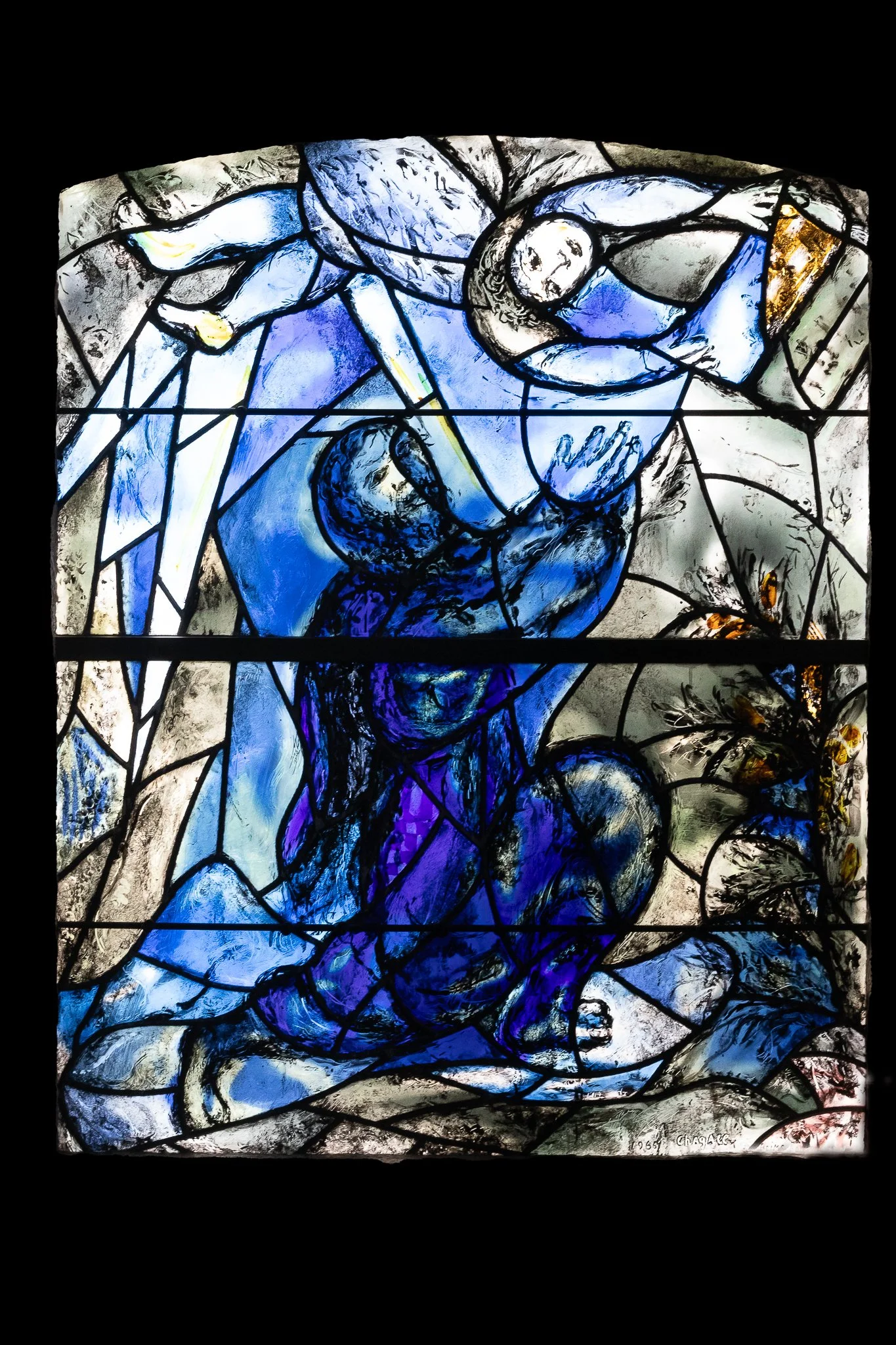
Ezekiel by Marc Chagall
Ann Bookman, a recent Pushcart Prize nominee, has published poems in Valparaiso Poetry Review, Soul-Lit: A Journal of Spiritual Poetry, Chronogram, and Dogwood: A Journal of Poetry and Prose, among others. In 2012, she published a chapbook, Point of Attachment, with Finishing Line Press. Her first full collection, Blood Lines, was published by Kelsay Books in the spring of 2022. She currently serves as Poet-in-Residence at the John D. O’Bryant High School in Roxbury, MA where she works with students on their creative writing projects and assists in the production of their literary magazine. After a 40-year career in academia—including positions at Holy Cross, MIT, Brandeis University—she is now a Senior Fellow at the McCormack Graduate School of Policy and Global Studies at UMass Boston. She serves on the Board of the Hudson Valley Writers Center and the National Council of Graywolf Press. For more information about her poetry and career, please visit annbookman.com.