
A Literary Journal
The Secret of the Sunshine
I circled the building twice, dragging my two heavy suitcases, looking for the hotel’s entrance. I finally found it underneath the building, through an underground parking lot, where a soiled red carpet showed the way to an elevator. I was in an industrial area a few miles from Kansai International Airport, so I suppose not many people arrive on foot.
The check-in desk was an oddly positioned hole in the wall. I rang a bell and someone appeared, but I could see only his chin and chest, our faces hidden from each other. I took the key, full of foreboding.
At the end of eerily empty corridors, I found my room, and it confirmed my suspicions. For my last night in Japan, I had picked the cheapest hotel I could find online within a thirty-minute radius of the airport, but I had assumed it would be a dingy business hotel; I hadn’t even known sex hotels were listed online.
A slot machine and a vending machine offering sexy underwear stood in a corner and a huge massage wand and a bowl of condoms were by the bed, which faced a television screen so large it covered almost an entire wall. I flipped it on and was faced with a woman in a French maid costume fellating a pixelated organ, occasionally turning her gaze upwards to the camera. I stared for a moment, fascinated despite myself, then continued exploring the room. There was a bathroom with a jacuzzi and faux marble walls, a recess of which contained a flatscreen television. I turned it on: more blurred genitalia and moaning women.
I returned to the bedroom, sat down on the bed, and sighed. I had spent the day emptying out the last furniture and trash from the company-sponsored studio where I had been living. I now had no job, nowhere to live, and no longer a valid visa. What I did have were two overstuffed suitcases, the equivalent of nine hundred and thirty pounds that would need to tide me over until I found a new job, and a one-way ticket to Birmingham, where my brother still lived and had offered to let me crash. I also had depression and an all-consuming sense of failure. And here I was, on my first ever visit to a sex hotel. In Osaka’s grimy suburbs. Alone. What a sordid finale to a chapter of my life I wished to forget before it had even ended.
There was an ashtray next to the massage wand. I considered lighting a cigarette, but I was going to have to sleep in this room. I opened the shutters to see if I could smoke out the window, revealing a view of a concrete wall a few inches away; the window itself was locked shut.
I sat back down on the bed. On screen, the French maid was working away, occasionally lifting her eyes from the flesh-coloured pixels toward the camera.
Jesus. As broke and tired as I was, I couldn’t face spending the rest of the evening alone in here. There probably was nowhere to go in the area, but I could at least walk around. Perhaps find a convenience store.
With that end in mind, I grabbed my shoulder bag and headed out, picking a direction at random. It was all grey concrete and litter and highways, not a shop nor a person in sight: more like a snapshot of urban decline in America than a part of Japan’s second-largest city.
After a few blocks, I found a convenience store. There were no other clients. I bought a pack of Parliaments, then continued onwards.
I had been walking for perhaps twenty minutes when I saw the bar. I would’ve assumed it was permanently closed—after all, the streets were deserted—if not for the light-up sign in a window that, despite a burned-out bulb, proclaimed it was “OP N”
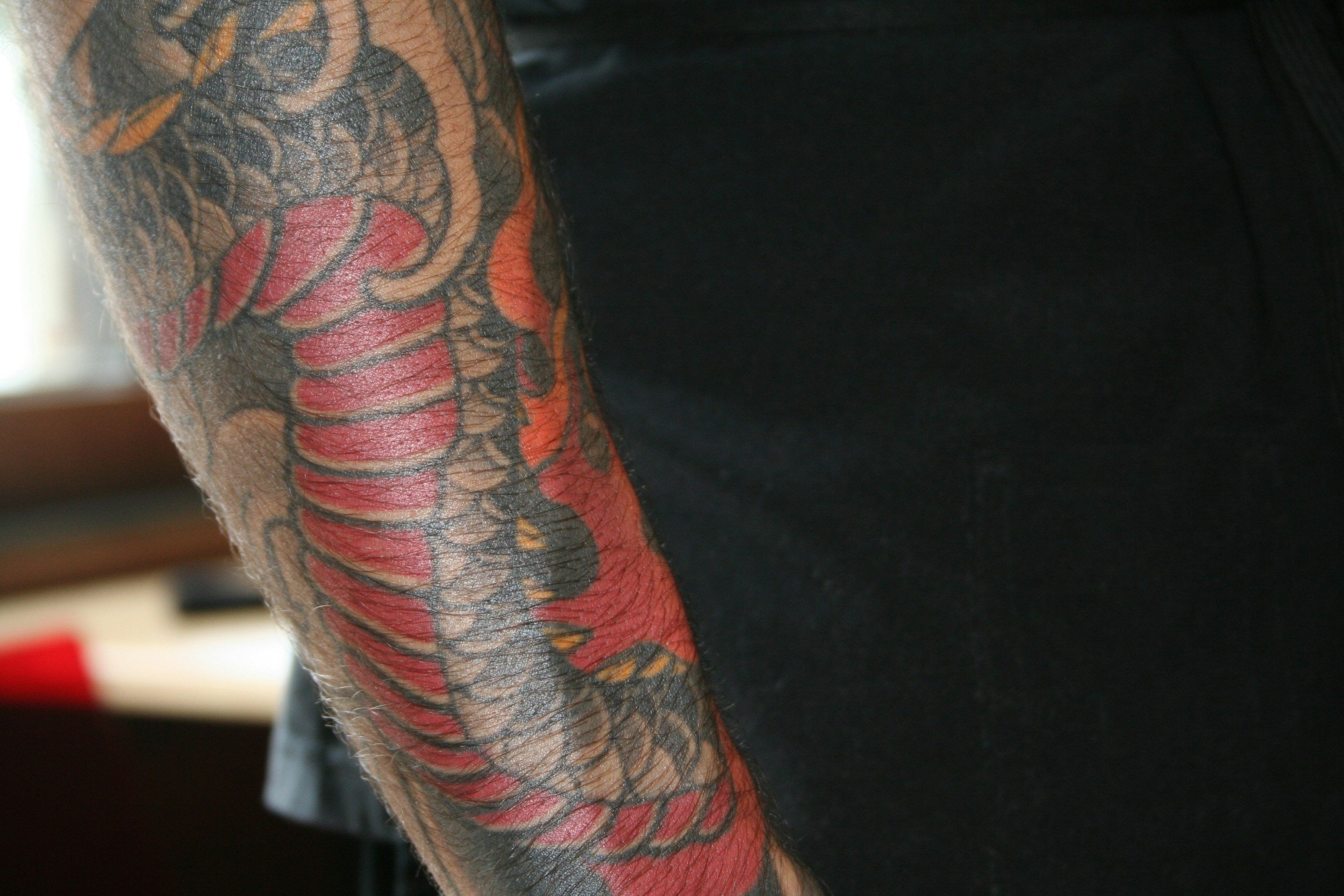
I pushed at the door gingerly. It gave way, and I stepped into darkness, enveloped by the smell of stale beer and fresh sweat and cologne. As my eyes adjusted, I saw it was a scruffy little dive, unlike the cheery, traditional izakaya I’d always been forced to go to with my coworkers. The bartender wore a wrinkled T-shirt and glared at me, as if I were a disturbance and ought to apologize. The only customer was nursing a whiskey at the counter. His hair was shaved at the sides and greased back in a thick mane on top. He wore a garishly patterned shirt, the sleeves rolled up to his elbows to reveal the edges of tattoos.
It wasn’t exactly my style, nor was it welcoming, but there didn’t seem to be any other options. I sat down at the counter, leaving a chair empty between me and the other customer.
“Beer,” I said simply.
The other customer looked up at the sound of my voice. He scrutinized me, then said, “Harō.”
I didn’t hello him back but merely threw a quick glance in his direction. I didn’t want to invite any conversation.
He wasn’t deterred. Carefully lining up the syllables as if they were wooden blocks spelling H-O-R-S-E, he said, “Yū—ā—berī—byū-chi-fu-ru.” You are very beautiful.
I doubted that very much. Sighing, I turned to him. “I speak Japanese, you know,” I said in not-too-polite Japanese.
“Oh, do you now!” He switched to Japanese himself, his face lighting up. Then he moved over to sit immediately next to me, sliding his whiskey over the counter. The pattern on his shirt was peonies and chains.
“But I don’t really feel like talking.” I turned resolutely to face the bartender, then buried my face in the oversized beer mug.
“Really?”
I frowned. Shutting down interactions with unknown men was a reflex, but come to think of it, perhaps I did want to talk—or did I?
Unable to decide what I wanted, I shrugged. This was encouragement enough for him.
“I’m Taku,” he said. “What’s your name?”
“Emma.”
“Do you have a boyfriend, Emma?”
I rolled my eyes, beginning to turn away again. Then I decided, what the heck. I can tell him anything.
It was the truth that came out. “No. I had: Eric. He was an English teacher at an eikaiwa.” An eikaiwa was an English conversation school for adults.
“What happened?”
“He started fucking one of his students, so that was that.” I shrugged, dissembling the intense pain I felt at the memory. Megumi had been tiny and elegant, one of those women who carries a frilly umbrella and is manicured with cutesy nail art. Seeing her had made me feel like a barbarian elephant; no wonder Eric had preferred her, especially given my current state of slovenly depression.
Taku thought for a moment. “So … you don’t have a boyfriend anymore, then?”
I sighed. “No. I also no longer have a place to live, or a job, or savings. Or hopes or dreams,” I added in a melodramatic moan. I had meant to be funny, but as I said it, a wave of self-pity engulfed me and real tears gathered in my eyes. I pushed the beer out of the way, crossed my arms on the bar top, and laid my head on them, closing my eyes.
“There, there,” Taku was saying, patting me awkwardly on the back.
It felt good, until the movement of his fingers slowed and became more of a caress than a pat. I shook him off like a dog trying to get water out of its fur.
Taku removed his hand, then asked, “If you don’t have a place to live, where are you staying tonight?”
I wiped my eyes with a cocktail napkin. “At a hotel called the Sunshine. I’m flying out early tomorrow. Going back to Birmingham. My brother has a bean-bag I can sleep on.” I didn’t know how to say “bean-bag” in Japanese, so I just said “bag.” Taku didn’t react to this piece of information, though, hung up on something I had said earlier.
“The Sunshine? Did you say the Sunshine?”
“Yes.”
He frowned, looking as if he was trying to remember something. “Isn’t that a love hotel? I think I’ve been there.”
“Yeah. I didn’t realize when I booked online.”
His voice softened. “Huh. You really are going through a rough time, aren’t you?”
I was being pitied by some low-level gangster who spent his evenings drinking alone in the dive bar God forgot. It was too much. The sheer humiliation of it drew me out of my hole of self-pity. I sat up straight.
“So what about you, Taku?” I said, challengingly. “What do you do? And what’s with the tattoos?” I nodded towards his arms.
“Ah, hehehe, you noticed,” he said, getting almost coquettish. He pulled at his sleeve to reveal another half-inch of skin. “I can show them to you later.” He winked.
“Never mind that. Aren’t tattoos a yakuza thing in Japan?”
He looked starkly surprised at the word, and to my horror, I realized perhaps he was a member of the yakuza and hadn’t expected me to be such an idiot as to say it openly. It had never occurred to me I might meet one in reality.
But then he responded, “Yes, well, mostly they are, but I’m just an honest worker. I work in demolition.”
“What do you demolish?”
“Anything,” he said, proudly. “I operate excavators and bulldozers. But I dream of one day getting to operate a wrecking ball and demolish something really big.”
“Well, cheers to that,” I said, raising my glass.
At least someone had hopes and dreams.
* * *
Several beers and some foul-tasting shots later, Taku began to tell me about the secret of the Sunshine.
“So I told you I’d been there, right? Well, I had gone there with Kii-chan—Kii-chan is this hostess I used to go out with sometimes, total babe—and we had checked in, and we were in the room about to get it on, when Kii-chan noticed something strange on the wall.”
“What was it?”
“I’ve thought about it a lot since then,” he said, his eyes fixed at some point beyond the shelves of bottles behind the bartender, “and I’ve wondered if it’s a sort of Easter egg—you know, like in games and movies—but for love hotels. But I’ve been to many other love hotels since”—a lewd, self-satisfied smile floated on his lips at the implication—“and I have never found anything like it. So I believe it must be something about the Sunshine.”
“But what was it?” I insisted.
He turned his gaze back to me, a little surprised, as if he had forgotten I was there. “Well, it was …” he began, then paused.
”Yes?” I prompted. “Tell me.” I was madly curious, and my drunkenness made me obnoxiously obstinate.
He let out a sigh. “It’s hard to explain, and anyway, if I told you, you wouldn’t believe me.”
“Oh, come on. You can’t not tell me now!” I gave him a belligerent but feeble shove. His bicep was surprisingly, reassuringly solid.
“Well …” He hesitated again, rubbing his chin and glancing down on the arm I had just ineffectually pushed at. “Perhaps I can show you? I am fairly certain it’s in every room—and even if it isn’t, I know which room Kii-chan and I were in, so we could ask the staff to let us in. Or just rent the room for an hour, if they’re being difficult about it.”
“You really can’t just tell me?” I asked, frowning and slurring my words slightly. I wanted to know now and not at the end of a long walk.
He shook his head. “No. There’s no way I could describe it properly.”
“Fine,” I said, making up my mind and getting unsteadily to my feet. “Let’s go.”
“Now?”
“Yes, of course now. Excuse me,” I called to the bartender who was idly looking at his phone. “Could we get the tab, please?”
* * *
We were about halfway to the hotel when I noticed that Taku was not so much walking as strutting. It occurred to me then that I was walking to a love hotel, very drunk, in the evening, with a stranger who was possibly a low-level yakuza. Not ideal.
I stopped in my tracks, swaying slightly. Taku reached out a hand to steady me, and I swatted at the polyester peonies of the shirt sleeve.
“Stop that. I’m fine. But I need you to know, you know, that we’re only going back to the hotel so that you can show me that thing you were talking about.”
“Of course,” he said, his face a picture of guileless honesty, as if he had no idea what other reason we could possibly have to go there.
“No funny business, okay?”
He looked affronted. “Of course not.”
“As in, no touching,” I clarified. “No monkey business. No hanky-panky.”
He nodded. “Yes: got it. None at all. Nuh-uh, ma’am.”
I narrowed my eyes at him. “On your honour?”
“On my honour,” he said with a flourish.
Satisfied, I nodded. “And remind me to double-check that I set the alarm on my phone for tomorrow,” I said as I resumed walking, remembering with a pang that I was leaving Japan the next morning.
“I already have. And you already did. But I will remind you again.”
The hotel was still eerily empty when we arrived. We padded along the soiled red carpet of the hallway to my room, and I unlocked the door wordlessly. The room was dark save for the glittering bulbs of the slot machine and the cold blue light emitted from the sexy-lingerie vending machine. I flicked on the lights and turned towards Taku, then let out a squeal to find him far closer than expected, his face right by mine, his eyes half-closed and his pursed lips in my personal space and getting closer, like an octopus suction cup with a homing device.
I pushed at him, then elbowed him in the chest when that was ineffectual.
He let out an “oomf,” backing away.
“What the hell are you doing?” I hissed. “We said no funny business!”
He stared at me uncomprehendingly.
I sighed. “I just want to see that special feature you were telling me about. The Easter egg. That’s all. Now, what is it?”
“But … there isn’t any,” he said, shaking his head. “I was just making that up to intrigue you.”
“There isn’t any?” I repeated, equally in disbelief.
“No, of course not! I thought you realized it was just a joke.”
It felt like all the air went out of me, so deep was my chagrin. I had been so looking forward to finding out. And yet, deep down, had I known there was no secret and set myself up for disappointment?
I dropped my shoulder bag on the floor and sat down on the sofa, feeling tears of self-pity and self-disgust rise to my eyes. Taku began to approach but I raised a palm towards him, and he stopped.
“I’m sorry,” he said, his voice gentler. “It really hadn’t occurred to me that you actually believed me. Or that you cared so much to see the … Easter egg.”
Breaking down in front of Taku would’ve been a final indignity, but thankfully, his incredulity and pity lit a spark of anger in me. I grasped at it, channelling the full weight of my disappointment into it—all my disappointments, my sadness, my anxiety, my fury with myself. In a moment, the spark was a raging bonfire.
“Of course I believed you,” I spat. “I have some basic expectations of other human beings; for one, I don’t assume they lie about everything, or that they’d lie to someone’s face like you did. And you didn’t just lie to me and disappoint me—because I was really excited to find out. You made false promises, and you tried to take advantage of me.”
He held up his palms. “Hey, hey, hey, I was not trying to take advantage of you—I really thought you were into me.”
“What, when I even stopped you on the way here to make sure you understood? You promised, no funny business!”
“I thought you were in on it,” he shouted. “I mean, for what else than funny business would a couple be heading to a love hotel late at night?”
For the Easter egg, I wanted to shout back, but I stopped myself. He really did seem to have believed I wanted to hook up with him, and I was feeling sillier and sillier at my own naïveté. It wasn’t a good feeling; I wanted to go back to anger.
“You swore on your honour that there’d be no funny business,” I hissed. “Does that mean nothing to you?”
“I thought you were just joking,” he said, increasingly exasperated. “Look, I’m not going to lay a finger on you—it was just a misunderstandi …”
I cut him off. “Is this the Yamato spirit? Is this the code of the samurai? You promised on your honour. I always thought face and honour were important to the Japanese.” I stood up, facing Taku, then looked him up and down, letting my eyes linger on the traditional Japanese, possibly-yakuza tattoos on his arms that he seemed so proud of. “Apparently, I was wrong.”
Taku’s expression was a mixture of anger and hurt.
Good, I thought. My own anger began to dissipate at the sight of his. I sat down again, resting my chin on my hands.
“I’m sorry I lied to you,” he said after a moment, teeth clenched. He took a deep breath, releasing some of the tension in his body. “I do value honour. I have honour. And I will prove it to you.”
“Forget it,” I said, suddenly exhausted. I just wanted him gone. “Just go.”
But I had touched a nerve, it seemed. “No. I must demonstrate to you the spirit of the samurai and restore the honour of Yamato.”
I closed my eyes for a long moment, feeling I could fall asleep where I sat, then sighed. I supposed I ought to give him a chance to restore his honour. “Fine. How, exactly, are you going to do this?”
His face fell. “I’m not sure.” He stared out into nothingness, deep in thought, then added, “I’ll figure something out. Let me borrow the toilet, then we’ll get out of here.”
I closed my eyes, entering that state between wakefulness and sleep where real sounds intermingle with dream images. I saw a terrifying, man-sized Easter bunny—that was presumably a dream—then I heard rustling and movement near me. I awoke with a start to see Taku leaning over my shoulder bag.
“What are you doing?”
“Nothing,” he said, straightening up. “All right, I’m ready. Let’s go.”
* * *
“Well?” I asked for the third time, wrapping my arms around myself for warmth; my exhaustion made me shiver despite the balmy summer night.
We were standing outside the same convenience store where I had bought cigarettes in the early evening. Taku was on his third cigarette; I had refrained, knowing it would only make me nauseated at this point.
“Soon,” he said. “I’ll think of something.”
I would probably have crouched down and fallen asleep right there at the 7-Eleven smoking corner, had the something not then presented itself in the form of approaching voices—a high-pitched female one and an angry male one. It was a couple walking towards the convenience store; the way the woman was walking quickly, slightly turned away from the man, suggested it was he who insisted on following her. They stopped in front of the store entrance, their argument getting louder.
“Hey, hey, hey,” Taku said, walking towards them. “What’s the problem here?”
The girl looked up, but the man didn’t seem to have heard him, continuing to shout at the woman.
He waved an arm in front of the man and raised his voice. “I said, what’s the problem here?”
The man finally took notice of Taku and turned towards him. “It’s none of your goddamn business, that’s what it is. Now, get lost,” he spat before returning his attention to the woman, resuming his angry tirade as if he had never been interrupted.
Taku crossed his arms in front of his chest, and I noticed he was flexing his muscles, making his biceps strain against the silky shirt and showing off the veins on his tattooed forearms. “Look, man, I think I can be of help, so no need to give me that attitude. Why don’t you tell me what your argument is about?”
The man turned towards Taku again, livid, but then he appeared to see Taku for the first time. He took in Taku’s beefy arms, tattoos, and druglordesque shirt, and some of the belligerence oozed out of him. Whether he decided Taku would be on his side, or that Taku was someone he wouldn’t want to piss off, I couldn’t tell; perhaps it was both. At any rate, he took a deep breath and got his anger under control, for the moment.
“Our argument,” the man said, “is about the fact that she scammed me. Fifty thousand that I might as well have flushed down the toilet in Club Passion Lolita for all I got out of it. I mean, I get that there are extra fees for certain things—it’s not the first time I’m doing this—but when you pay for the …”
Taku the Diplomat was listening closely, interjecting questions and clarifications every so often. I didn’t understand any of the jargon—option play, fashion health, real performance—so instead, I observed the woman. She wore a slinky mini-dress showing most of her legs and much of her cleavage, far too revealing for what Japanese fashion dictated but normal, I supposed, for someone working at a hostess club or soapland brothel. When I got closer, I saw she was heavily made up with false lashes and pancake that had creased under her eyes. She looked even more tired than I felt.
I returned my attention to the men. Whatever the angry man had been saying, it didn’t seem to have convinced Taku, who was looking increasingly dubious. The man had worked himself back up into an angry frenzy, and when he decided he wasn’t getting either sympathy or help from Taku, he turned back towards the woman. “I paid for the full course—I want my money back,” he bellowed, reaching out to push roughly at her shoulder. She let out a yelp of surprise, wobbling in her stiletto sandals.
“Hey!” Taku stepped in between them. “What the fuck, man? Don’t touch her.”
The man’s anger bubbled over. He pushed at Taku’s chest with both hands. Taku staggered backwards, but I managed to pull the woman out of the way before he crashed into her. I caught a glimpse of Taku; his face had lit up. This was his chance.
His sleeves were already rolled up, but he carefully rolled them up an extra centimetre, then cracked his neck ostentatiously. Looking at the tired hostess/prostitute, he said, “Miss, I’ll take care of this. Why don’t you go home and get some rest.”
The woman stared. Perhaps she couldn’t decide what was better: getting to watch the denouement, or taking the opportunity to get out of there. Finally, she nodded and left as quickly as her wobbly stilettos would let her.
“Hey!” the man yelled. He made as if to run after her, but Taku grabbed him, holding him back. The man turned towards Taku, his fist raised.
I stood transfixed. I had never seen a real fight before.
At the sight of Taku, I suspected he hadn’t either. His face was that of someone who has never sung in public who suddenly finds himself with a karaoke mic shoved into his hands and an expectant audience in front of him. His body tensed up, and he held his fists up in front of his face in a passable imitation of a boxer.
It turns out, real-life fights are quite different from in the movies. For one, the sounds are surprisingly muted. When Taku’s fist hit the angry man’s face, there was no resounding pa-chow!—just a slight ptsh, almost drowned by the sound of their grunting and breathing. And there were no dozens of punches exchanged; just the one that missed Taku and the one that hit the angry man in the face. Then the fight was over. The angry man—now more panicked than angry—was holding his hands over his nose, whining, “I’m bleeding! Look what you did. I’m bleeding!”
Taku was standing back, hovering uncertainly, as if unsure if he should continue the fight or do something to help the man stifle his nosebleed. He looked over his shoulder towards the 7-Eleven, then stepped towards me.
“Emma. You need to get out of here; the police will be here soon.” He nodded towards the convenience store. Through the glass windows, I saw the clerk looking at us, a phone clasped against his ear, his mouth moving.
“But we haven’t done anything wrong,” I protested.
“You have an early flight tomorrow. Do you really want to spend the next three hours at a police station answering questions and filling out paperwork?”
He was right. I was already beyond exhausted and worried I would sleep through my alarm. I nodded my assent.
Taku walked back towards the angry man, who was sitting on the ground, dabbing ineffectually at his nose and groaning. The blood-red peonies on Taku’s silky shirt strained over the muscles of his chest. He looked like Clint Eastwood in a Western movie, the orange, white, and green fluorescent lights of the 7-Eleven substituting for a desert sunrise.
Glancing over his shoulder, Taku saw me still rooted to the spot. “Go!” he shouted.
I began to run, but after a few yards, I stopped and turned. “Hey, Taku?”
“What?”
“You look really cool.”
He grinned and ran his hand through his hair. “I know.”
* * *
I woke up with a start to a piercing ringing, still in my clothes from the night before, feeling nauseated and too warm. When I rolled over and saw the slot machine in the corner of the room, I remembered where I was and what day it was, and my heart rate instantly doubled. It seemed to double again when I looked at my phone and realized my alarm had been going off for forty-five minutes while I slept.
I just barely made it to my flight. I was the last one to board, panting and clammy with rapidly cooling sweat after running through the airport as fast as my nausea and bulky hand luggage would allow me. I squeezed past two other passengers to the window seat, stowed my bulging shoulder bag under the seat in front of me, and fastened my seatbelt. Then I sat still for a moment, bewildered at having gone from a race against the clock, running and lugging and sweating, to suddenly having twelve hours of nothing to do.
Twelve hours. Twelve hours of wallowing in disgust at everything I had done wrong, twelve hours of seething at everything everybody else had done me wrong.
I pulled out my bag again and rummaged for the crime novel that I’d been reading on and off for the past few weeks. When I extracted it from the bag, a piece of paper fluttered onto the floor. I groped blindly for it, trying not to bump my face on the knee of the person in the next seat, and finally caught it between my fingers. It was a page apparently ripped from a pocket agenda, folded in half. On the outside of the paper were drawn a shingled roof, rows of squares—windows, as the presence of stick-figure people inside some of them attested—and a sign reading THE SUNSHINE.
I unfolded the sheet. Inside was a drawing of an egg, done entirely in blue ballpoint pen but decorated with great skill with intricate arabesques, peonies, chains, and a koi fish, like a tattoo or an old woodblock print. An Easter egg in the Sunshine.
Taku, you are a man of honour, I thought, my eyes watering. As the plane took off and I looked down at the rapidly miniaturizing Osaka underneath us, I felt a shadow of that tug of fascination that had first drawn me to the country so long ago. For a moment, it made the city seem to glitter.
If my own failings were not irredeemable, I told myself, if I pulled myself together, then one day, someday, I would try again.
ALICE NORD
Alice Nord is a biomedical scientist working as a medical writer. She grew up in Sweden, went to college and graduate school in the U.S., and now divides her time between Japan and France. Her short fiction has appeared in the Kyoto Journal, Saturday Evening Post, Porter House Review, and other journals.